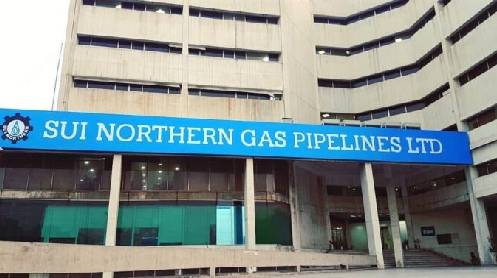
ISLAMABAD: State-owned Sui Northern Gas Pipelines Limited (SNGPL) has sought an extension of the federal government’s sovereign guarantee until June 30, 2030, citing mounting financial pressures caused by accumulated receivables, frozen gas tariffs, and the diversion of expensive re-gasified liquefied natural gas (RLNG) to subsidized domestic consumers.
According to official sources, SNGPL has informed the government that it is currently unable to repay a Rs50 billion commercial loan obtained to clear outstanding payments owed to Pakistan State Oil (PSO) for RLNG supplies.
The Petroleum Division has attributed Rs819 billion in primary receivables to the government’s prolonged policy of delaying consumer gas tariff revisions and diverting costly imported RLNG to the domestic sector at prices below cost, creating a significant tariff differential that gas utilities have been unable to recover.
Gas Circular Debt Remains a Major Challenge
Sources said Pakistan’s gas sector has been grappling with circular debt since FY2013, primarily due to insufficient or delayed increases in consumer gas prices, which prevented gas utilities from fully recovering the cost of gas purchased from producers.
Although regular gas tariff revisions since November 2023 have largely halted the accumulation of new circular debt, financing costs continue to rise. As of December 2025, SNGPL’s receivables had reached Rs1.095 trillion, while accumulated late payment surcharge (LPS) had climbed to Rs931 billion.
IMF-Backed Gas Circular Debt Management Plan
The Petroleum Division, in collaboration with the Task Force on Power Reforms and consultancy firm KPMG, has developed a Gas Circular Debt Management Plan (GCDMP) to address the sector’s long-standing financial challenges.
The plan was presented to the International Monetary Fund (IMF) in March 2026 and again in May 2026, with subsequent IMF queries having been addressed. According to the third review of Pakistan’s IMF Extended Fund Facility (EFF), the government expects to implement the plan during FY2026-27, subject to the necessary approvals.
Rs50 Billion Loan Backed by Sovereign Guarantee
In 2023, the Economic Coordination Committee (ECC) approved a proposal allowing the Finance Division to provide a sovereign guarantee and a Letter of Comfort to enable SNGPL to secure Rs50 billion in commercial financing for RLNG payments to PSO and Pakistan LNG Limited (PLL).
Following the decision, the Finance Division issued sovereign guarantees covering financing from Allied Bank (Rs20 billion), Faysal Bank (Rs20 billion), and the National Bank of Pakistan (Rs10 billion).
The guarantee was initially valid until June 2026, with the condition that SNGPL would demonstrate its ability to repay the loans upon maturity.
Financing Shift to Meezan Bank
Subsequently, one of the consortium lenders, Faysal Bank, reportedly sought early settlement of its financing share.
After discussions with several financial institutions, Meezan Bank agreed to assume the entire Rs50 billion financing at improved terms of three-month KIBOR minus 30 basis points, replacing the previous one-month KIBOR-based facility.
According to the Petroleum Division, the refinancing arrangement is expected to reduce SNGPL’s annual financing costs by approximately Rs150 million.
Financial Constraints Persist
Despite recent gas tariff adjustments helping to slow the growth of circular debt, SNGPL has informed the government that it lacks sufficient financial resources to retire the accumulated liabilities.
The utility cited the continued diversion of RLNG to lower-paying domestic consumers and declining demand from the captive power sector as major factors constraining its cash flows.
As a result, the company has been unable to propose a viable repayment mechanism for the outstanding Rs50 billion loan and has formally requested the government to extend the sovereign guarantee issued in favour of Meezan Bank until June 30, 2030.
The request highlights the persistent financial challenges facing Pakistan’s gas sector despite ongoing tariff reforms and efforts to restore the long-term sustainability of the country’s energy supply chain.
Story by Zafar Bhutta