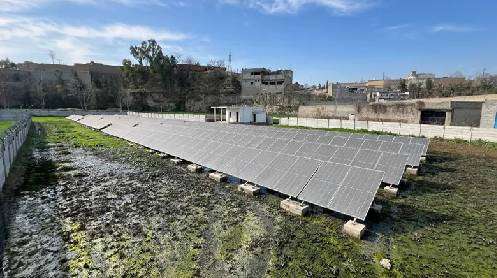
**KARACHI:** Energy experts, economists and policy specialists have urged the government to make solar power more affordable for heat-stressed and low-income households, stressing that equitable access to clean energy is essential for Pakistan’s long-term energy security and climate resilience.
The recommendations were made during a seminar titled **”Pakistan’s Energy Security: The Reality for Working People,”** jointly organised by **The Knowledge Forum (TKF)** and the **Karachi Union of Journalists (KUJ)** at the Karachi Press Club.
Speaking at the event, former adviser to the chief ministers of Sindh and Balochistan, **Dr Kaiser Bengali**, said governments should provide relief to citizens during times of crisis rather than increase their financial burden through higher taxes. Drawing a comparison with Australia’s response during the Gulf War, he noted that Australia reduced taxes to support its people, whereas Pakistan has traditionally relied on additional taxation.
Dr Bengali also criticised the increase in petroleum prices during the recent regional conflict and proposed the introduction of a soft-loan programme to enable low- and middle-income households to install rooftop solar systems. He further suggested imposing a monthly petrol ration of **150 litres per vehicle** to reduce fuel consumption.
Public finance expert **Sadya Siddiqui** highlighted growing inequality in Sindh, noting that the province recorded an inequality rate of **35.9%**, compared to **32% in Punjab** and **26% in Balochistan**, citing the **Economic Survey 2024-25**.
She said recurring climate-related disasters, including heatwaves and floods, continue to force provincial governments to divert significant resources toward rehabilitation efforts. Climate risk, she added, has now been officially recognised as posing a greater threat to Pakistan’s economy than revenue shortfalls or foreign exchange crises.
Siddiqui also pointed to limited solar adoption and inadequate electricity access in districts such as **Jacobabad** and **Tharparkar**, citing findings from the Household Integrated Economic Survey (HIES).
**Basil Andrews**, climate and energy policy expert at TKF, said households in the lowest income group spend more than **60% of their income** on electricity and cooking fuel. He noted that the rapid growth of rooftop solar primarily benefits higher-income consumers, while residents of Karachi’s multi-storey buildings often lack access to rooftop space, limiting their ability to adopt solar energy.
Other participants called on policymakers to align electricity planning with affordability, climate resilience and social welfare, emphasizing that improved access to reliable and affordable energy is critical for public health, economic stability and the well-being of women and vulnerable communities.