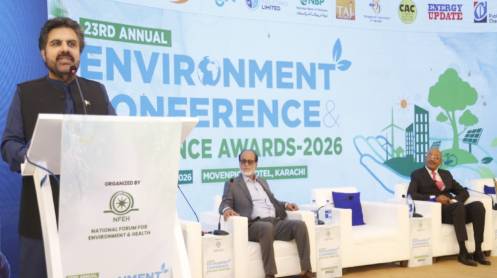
23rd Annual Environment Conference and Awards – 2026
Sindh emerges as Pakistan’s leader in climate action with carbon market reforms, mangrove restoration and smart environmental governance: Nasir Hussain Shah
Karachi
Sindh Minister for Local Government, Housing & Town Planning, Syed Nasir Hussain Shah, has said that Sindh has become the first province in Pakistan to successfully implement a government-led carbon credit project, enabling the country to earn substantial foreign exchange through its internationally acclaimed mangrove restoration programme while reaffirming its unwavering commitment to environmental protection and climate resilience.
Addressing the 23rd Annual Environment Conference and Awards-2026, organised by the National Forum for Environment & Health (NFEH) under the theme “Reclaiming Pakistan’s Liveable Future: From Collateral Damage to Collective Ownership”, the minister said the Pakistan Peoples Party-led Sindh Government had recognised the urgency of climate change and taken pioneering measures to transform environmental conservation into sustainable economic opportunity.
He said Sindh’s globally recognised mangrove plantation campaign in the Indus Delta had laid the foundation for Pakistan’s first governmental carbon credit initiative, generating significant annual foreign exchange earnings, with a substantial share of the proceeds benefiting Sindh due to its successful restoration of mangrove forests.
Nasir Hussain Shah said the Sindh Government was further strengthening its climate governance framework by modernising environmental institutions and aligning them with international best practices. He announced that the Sindh Environmental Protection Act (SEPA) was being amended to make it more transparent, efficient and fully responsive to emerging climate change challenges while bringing the province’s environmental regulatory framework in line with international standards.
He said a dedicated Directorate of Carbon Credits had recently been established under the Environment Department to facilitate climate finance and accelerate carbon market development. The department had also approved 13 carbon credit projects, which were currently at different stages of implementation and covered diverse sectors including mangrove restoration, riverine forests, biogas generation, agroforestry and landfill methane emission control.
Nasir Shah said the Sindh government had also launched urban forestry projects in Karachi and other cities to expand green cover and improve environmental conditions, while extensive plantation campaigns had been undertaken along irrigation canals and suitable open spaces across rural Sindh.
The minister said Sindh was also strengthening its environmental monitoring capabilities through the use of modern technology. Two fully automated air quality monitoring stations had already been installed in Karachi, providing real-time Air Quality Index (AQI) data based on eight to nine key environmental parameters, while plans were underway to install 17 additional automated air quality analysers across the province.
He added that the Sindh Environmental Protection Agency had also fully automated its environmental monitoring and No Objection Certificate (NOC) system to improve transparency, eliminate opportunities for inaccurate reporting and ensure greater accountability for both industries and regulatory inspectors.
He said the Sindh government, in partnership with the Asian Development Bank, was implementing the Jam Sakro Outfall Drain Project to protect communities in the coastal belt of Thatta district from flooding and improve climate resilience.
Referring to his tenure as Sindh Energy Minister, he said work had also been initiated to ensure that new high-rise buildings adopted energy-efficient designs to reduce electricity consumption and minimise carbon emissions.
On behalf of the Sindh government, the minister announced a matching contribution of 10,000 tree saplings for the NFEH’s monsoon plantation campaign in Karachi after the organisation had mobilised an equal number of saplings through private-sector support. He assured that the provincial government would provide suitable locations in parks and other public spaces to ensure the success of the campaign.
“The Sindh government firmly believes in partnering with non-governmental organisations and the private sector to expand urban green cover and promote environmental sustainability,” he said.
Nasir Hussain Shah said these initiatives reflected Sindh’s determination to position itself as Pakistan’s leading province in climate action by combining environmental conservation, technological innovation, institutional reforms and carbon market development to achieve sustainable economic growth and climate resilience.
Earlier, welcoming the participants, NFEH President Naeem Qureshi said the organisation’s monsoon plantation drive would be carried out entirely through philanthropic support from the private sector without seeking financial assistance from the government. He added that the campaign would also contribute to the restoration and beautification of Karachi’s public parks.
He observed that nearly 80 per cent of environmental challenges in urban centres could be effectively addressed through an empowered and efficient local government system capable of ensuring wastewater treatment, proper sewage disposal, prompt rainwater drainage to prevent urban flooding, sustainable civic infrastructure development and efficient municipal solid waste management.
Delivering the keynote address, Chairman of the Policy Research & Advisory Council, Younus Dagha, recalled that the catastrophic floods of 2022 had caused losses estimated at around US$9 billion, with Sindh suffering the largest share of the devastation.
He warned that cities and towns on the right bank of the Indus River remained vulnerable to future floods due to the continued absence of the Right Bank Outfall Drain (RBOD), regretting that no fresh budgetary allocation had been made for the crucial project. He also highlighted Karachi’s inadequate drainage infrastructure, saying it continued to expose millions of residents to urban flooding during heavy monsoon rains.
Dagha further stressed that timely completion of Karachi’s Bus Rapid Transit system could have significantly reduced carbon emissions from private vehicles. He also expressed concern over the continued discharge of untreated industrial effluents into the sea, which had severely damaged Karachi’s coastal marine ecosystem. He noted that stronger environmental safeguards, including increased urban tree cover, could have mitigated the impact of deadly heatwaves experienced in Karachi over the past decade.
Speaking on climate trends, Zainab Naeem, Environmental Research Fellow at the Sustainable Development Policy Institute, said Pakistan currently contributes around one per cent of global greenhouse gas emissions, while South Asia has emerged as one of the world’s most climate-vulnerable regions due to increasingly frequent extreme weather events.
AVM (Retired) Ejaz Malik, Chief Operating Officer of South Air, called for nationwide adoption of water conservation measures, urging Pakistan to replace the outdated flood irrigation system with modern drip irrigation to conserve precious water resources.
Energy expert Irfan Ahmed highlighted that air-conditioners accounted for nearly 60 per cent of Pakistan’s peak summer electricity demand of around 60 gigawatts. He emphasised that strict energy conservation and reduction of transmission losses were essential, noting that every unnecessary kilowatt-hour of electricity consumed resulted in the emission of approximately half a kilogram of carbon dioxide.
Chief Meteorologist Ameer Hyder Laghari of the Pakistan Meteorological Department said the department maintained close coordination with district administrations to facilitate timely responses to heatwaves, heavy rainfall and other extreme weather events. He added that increasing humidity in coastal cities such as Karachi had intensified uncomfortable summer conditions.
Former Chairman of the Pakistan Pharmaceutical Manufacturers Association, Dr Kaiser Waheed, called for specialised training of medical professionals to effectively manage diseases and health emergencies associated with climate change and environmental degradation.
During the conference, Syed Nasir Hussain Shah presented the Annual Environment Excellence Awards-2026 to 68 organisations and recognition awards to 14 companies for their contributions to tree plantation initiatives. He said the achievements of the award-winning organisations would inspire greater participation from the corporate, banking and industrial sectors in promoting environmental stewardship and sustainable development.
NFEH Secretary-General Ruqiya Naeem, Engineer Nadeem Ashraf, VP NFEH, Hassaan Ahmed, Manager Communications Climate Action Center, Karachi, Kashif Rasheed, Manager, MSC HSE and Digitalization, Mondelez Pakistan and other speakers also addressed the conference.