Goods, Oil Transporters’ Strike Continues as Talks Remain Deadlocked
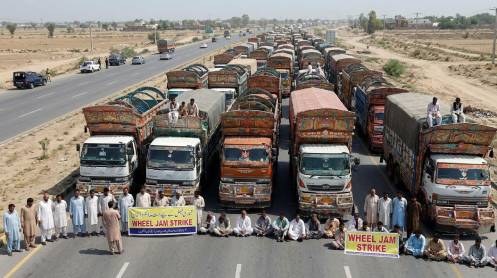
**ISLAMABAD/KARACHI:** Negotiations between the government and striking goods and oil transporters remained inconclusive on Monday, with both sides maintaining their positions over fuel pricing, taxes, axle-load limits and toll charges.
A fresh round of talks is scheduled for today as the government seeks to end the nationwide transporters’ strike, which has disrupted the movement of petroleum products, cargo and other goods.
Oil tankers, edible oil tankers, trailers and goods transport trucks went off the roads on Friday night ahead of the strike that formally began on Saturday. The government subsequently initiated negotiations with the All Pakistan Goods Transport Ittehad alliance, representing various transport associations.
The transporters have put forward three key demands.
Their first demand is an increase in the permissible weight for 10-wheeler vehicles from the existing 27.5 tonnes to 35 tonnes, along with a reduction in toll tax rates. The matter falls under the National Highways Authority (NHA) and the Ministry of Communications.
The second major demand concerns diesel pricing. Transporters have called for fuel prices to be revised on a monthly basis instead of daily, arguing that frequent price adjustments make business planning difficult.
Their third demand relates to customs duties and income tax, requiring coordination with the Federal Board of Revenue (FBR) and other relevant authorities.
The government negotiating team was jointly led by Communications Minister Aleem Khan and Petroleum Minister Ali Pervaiz Malik and included senior officials from the FBR, Ministry of Maritime Affairs and Ports and Shipping, federal ministries, as well as transport officials from the four provinces.
The first round of talks held on Monday morning ended without a breakthrough, while a second round continued later in the afternoon.
Spokesman for the transporters’ alliance, Advocate Mohammad Owais Chaudhry, said the transporters had clearly presented their demands and were not prepared to compromise on their position.
A senior government official, however, said the daily fuel price adjustment mechanism had been introduced in response to volatility in international oil markets and was not a domestic policy issue.
The government is nevertheless considering measures to address some of the transporters’ concerns, including a possible reduction in toll taxes for heavy vehicles and amendments to axle-load limits.
### Industry Fears Growing Economic Impact
The prolonged strike has raised concerns among businesses and exporters, particularly in Karachi, over disruptions to industrial production, supply chains, fuel availability and export shipments.
Karachi Chamber of Commerce and Industry (KCCI) President Muhammad Rehan Hanif urged the federal and provincial governments to immediately engage with transport sector representatives at the highest level.
He warned that a prolonged suspension of goods and petroleum transportation could have a cascading impact on the availability of raw materials, industrial production, delivery of finished goods, fuel supplies, domestic trade and export operations.
Hanif also urged transporters to consider the wider economic impact of the strike and offered KCCI’s services as a mediator to help resolve the dispute through negotiations.
Pakistan Textile Council (PTC) Chairman Fawad Anwar also expressed concern over the potential impact of the strike on the country’s textile and apparel supply chains.
In a letter to Prime Minister Shehbaz Sharif, Anwar said the industry depends heavily on uninterrupted transportation to move imported and locally sourced raw materials to factories and deliver finished export consignments to ports on time.
He acknowledged that the transporters’ demands involve several government departments and levels of administration but warned that the economic cost of the deadlock would continue to rise with each passing day.
He called on the prime minister to bring relevant government authorities and representatives of the transport sector together to secure an early resolution and restore the movement of goods and petroleum products.
Story by Kalbe Ali Aamir Shafaat Khan