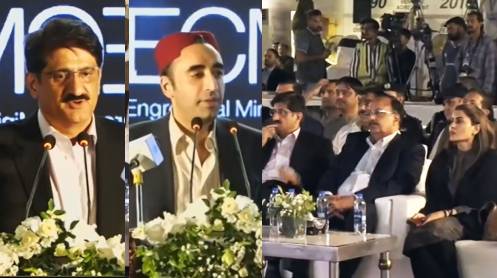
THARPARKAR: Pakistan Peoples Party Chairman Bilawal Bhutto Zardari inaugurated the Phase-III expansion of the Thar Block-II Coal Mine and Pakistan’s first-ever coal drying unit, marking a major development in Pakistan’s domestic energy supply and the continued transformation of Tharparkar into a national energy hub.
The Phase-III expansion has increased the mine’s production capacity from 7.6 million tonnes per annum (MTPA) to 11.2 MTPA, adding 3.6 million tonnes of annual coal production. Officials said the expansion was completed through 100 percent self-financing, reflecting investor confidence in Thar’s indigenous energy resources.
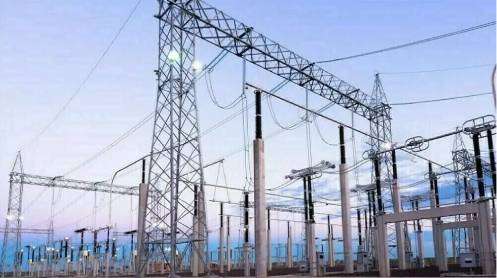
The additional coal production will supply Lucky Electric Power Company’s 660MW power plant, increasing the total electricity generation supported by Thar Block-II coal from 1,320MW to 1,980MW. The combined generation capacity is estimated to provide electricity to around 4.5 million households daily.
Officials said mine-mouth power generation based on Thar coal costs approximately $3.75 per MMBtu, making it significantly cheaper than imported coal. The Phase-III expansion is expected to generate annual savings of around Rs15 billion in power generation costs and $220 million in foreign exchange. Cumulative foreign exchange savings since the start of operations have already crossed $1.7 billion, according to project officials.
Addressing the ceremony, Sindh Chief Minister Syed Murad Ali Shah said the development represented the continuation of a vision initiated by former Prime Minister Shaheed Mohtarma Benazir Bhutto, who laid the foundation stone for a 2,640MW coal-based power project in Thar in 1996.
He said the project had faced years of delays and uncertainty but was revived after the PPP returned to power in 2008, with the Sindh government and private-sector investors working together to develop the region’s coal resources.
“If Thar changes, Pakistan will change. Today we can proudly say that we have delivered on that promise,” the Chief Minister said.
The expansion strengthens Thar’s role in Pakistan’s energy mix by increasing the availability of locally produced coal for mine-mouth power generation and reducing dependence on imported fuel.
The development is also being accompanied by investments in infrastructure and community services. According to the Sindh government, Thar has witnessed significant improvements in roads, healthcare, education, drinking water supply and access to electricity alongside the development of the coal and power projects.
Murad Ali Shah said the region had transformed from an area associated with drought and deprivation into a growing centre of economic activity.
He highlighted the development of roads, an airport, schools, hospitals, drinking-water schemes and solar energy projects in remote villages as part of the broader development around the Thar coal initiative.
The project’s social and community-development programmes have become a major component of the Thar development model. Through the Thar Foundation and support from the Sindh government, more than 500,000 patients have reportedly received free medical treatment, while over 12 million litres of clean drinking water are supplied every month.
More than 5,000 students are enrolled in educational institutions established through community-development initiatives, while solarisation, sanitation and livelihood programmes have benefited thousands of households.
The Sindh government also said that approximately 1.2 million trees have been planted under environmental conservation programmes, highlighting the growing focus on environmental rehabilitation alongside mining and energy development.
Employment generation has also remained a key part of the project’s local economic impact. According to the Chief Minister, 94 percent of employees and service providers associated with the project are from Sindh, while 60 percent are residents of Tharparkar.
The Sindh government further announced that a 50-bed Mother and Child Hospital in Islamkot would be completed within a year to strengthen healthcare services for local communities.
The Phase-III expansion comes as Pakistan continues to seek greater reliance on indigenous energy resources to reduce fuel-import costs and strengthen energy security.
With mine capacity now reaching 11.2 MTPA and Thar Block-II-supported generation increasing to 1,980MW, the project is expected to play a larger role in supplying electricity while reducing pressure on the country’s foreign-exchange reserves.
The Thar experience also demonstrates how an energy project can be linked with wider regional development through employment, healthcare, education, clean water, renewable-energy access and environmental initiatives.
The inauguration ceremony was attended by federal and provincial lawmakers, senior government officials, representatives of Sindh Engro Coal Mining Company (SECMC), Thar Foundation, local community leaders, development partners and residents from across Tharparkar.