UNITED NATIONS: Pakistan has called for urgent international action on climate finance, reform of the global debt architecture and stronger cooperation over shared water resources as the UN General Assembly’s (UNGA) Second Committee begins substantive discussions on economic and development challenges.
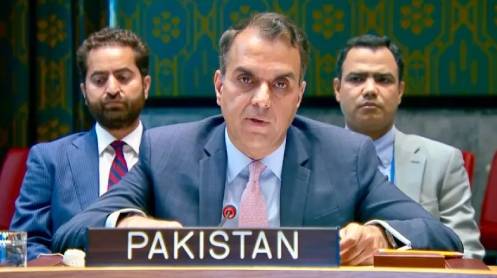
Speaking during the general debate of the Second Committee, Pakistan’s Deputy Permanent Representative to the United Nations, Ambassador Usman Jadoon, urged member states to focus on delivering tangible outcomes on some of the most pressing economic, financial and development challenges facing developing countries.
The Second Committee addresses economic and financial issues, including development financing, international trade, debt, climate change, technology and sustainable development. Its deliberations focus on translating international commitments into practical policies and frameworks.
Pakistan Calls for Greater Climate Finance
Climate finance and water cooperation featured prominently in Pakistan’s intervention.
Jadoon called for a credible pathway to mobilise $300 billion in climate finance, including grants and concessional financing. He also urged the international community to triple adaptation finance and ensure adequate capitalisation of the Loss and Damage Fund.
Pakistan also backed Türkiye and Australia’s efforts to make the upcoming COP31 a “COP of delivery”, stressing that climate commitments must result in concrete resources and action for vulnerable developing countries.
The issue is particularly important for Pakistan, which remains highly vulnerable to climate-related disasters while facing significant financial constraints in responding to their impacts.
Call for Respect for Water Treaties
Jadoon urged the UN Water Conferences scheduled for 2026 and 2028 to address the full spectrum of global water challenges, with particular emphasis on cooperation over shared water resources.
He stressed the importance of respecting international law and upholding the sanctity of existing water treaties.
The remarks carry particular significance for Pakistan given its dependence on transboundary water resources in South Asia.
$4 Trillion Financing Gap
Pakistan also highlighted the broader financing challenges confronting developing economies, noting that the annual financing gap for achieving the Sustainable Development Goals (SDGs) is estimated at around $4 trillion.
Islamabad proposed several priorities to help close the gap, including greater support for domestic resource mobilisation, expanded international public finance, development assistance and reforms to the global financial system.
Pakistan supported negotiations on a UN Framework Convention on International Tax Cooperation, arguing that the eventual framework should promote a fairer distribution of taxing rights.
Islamabad also urged developed countries to fulfil their commitment to provide 0.7 per cent of gross national income in official development assistance (ODA).
It called for progress on tripling multilateral development bank lending capacity, improving lending terms and reducing borrowing costs, including through more equitable credit-rating practices.
Pakistan Pushes for Debt Architecture Reform
Pakistan further called for comprehensive reform of the international debt architecture and greater representation for developing countries in institutions responsible for shaping global financial policies.
Jadoon highlighted Pakistan’s contribution to these efforts, noting that the country had served as vice-chair of the working group that guided the launch of the Borrowers’ Platform.
He said Pakistan would continue supporting the platform and called for the immediate launch of an intergovernmental process on debt.
Calls for WTO Revival
Pakistan also urged the international community to restore international trade as a key driver of sustainable development and revitalise the World Trade Organization (WTO).
Islamabad called for the restoration of the WTO’s two-tier dispute settlement mechanism, protection of special and differential treatment for developing countries, concrete progress on agriculture negotiations and an end to unilateral trade-restrictive measures, including those introduced in the name of environmental protection.
AI Could Widen Development Divide
The Pakistani delegation also highlighted the emerging economic implications of artificial intelligence (AI).
Jadoon warned that AI could become the “new face of the development divide”, with developing countries at risk of falling further behind in access to technology, skills, infrastructure and investment.
Pakistan called for greater emphasis on the development dimension of AI governance, including the operationalisation of the World Summit on the Information Society (WSIS+20) AI capacity-building fellowship.
Islamabad also urged concrete progress towards establishing a global fund for AI, aimed at ensuring that developing countries can participate more effectively in the rapidly evolving digital economy.
Story by Anwar Iqbal