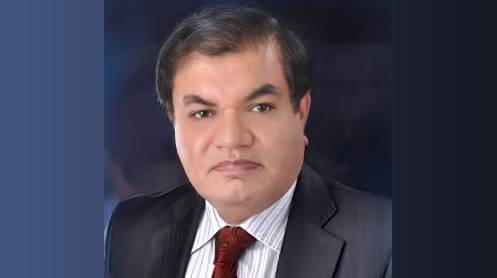
KARACHI: Mian Zahid Hussain, President of the Pakistan Businessmen and Intellectuals Forum and All Karachi Industrial Alliance, Chairman of the National Business Group Pakistan and FPCCI Policy Advisory Board, and former Provincial Minister for Information Technology, has called for a comprehensive strategy to boost Pakistan’s exports to the United States, warning that rapidly rising imports and sluggish export growth could weaken the country’s bilateral trade surplus.
Thank you for reading this post, don't forget to subscribe!He said Pakistan must capitalise on its cordial diplomatic relations with Washington to secure greater market access for Pakistani products, strengthen foreign exchange earnings, expand industrial production and create export-oriented employment opportunities.
According to the State Bank of Pakistan’s October 2026 report, Pakistan’s export receipts from the US increased by 4.44 percent year-on-year to $1.716 billion during July–September 2026, while imports from the US surged by 45.44 percent to $659.2 million. During the corresponding period last year, exports stood at approximately $1.64 billion and imports at $453.3 million.
Mian Zahid Hussain pointed out that imports increased by around $206 million, compared with an increase of approximately $73 million in exports. Consequently, Pakistan’s bilateral trade surplus with the US declined from nearly $1.19 billion to $1.06 billion, representing a contraction of approximately 11.2 percent.
Highlighting the significant opportunities available to Pakistani exporters in the American market, he cited data from the World Bank’s World Integrated Trade Solution (WITS). US imports of cotton jerseys, pullovers and similar garments reached $7.35 billion in 2025, of which Pakistan supplied approximately $502.3 million. Similarly, US imports of cotton bed linen amounted to $1.18 billion, with Pakistan contributing $246.8 million.
He said the United States imported cotton towels and bathroom and kitchen linen worth $2.01 billion, while Pakistan’s share stood at $512.4 million. In medical, surgical and veterinary instruments, US imports under the relevant broad category reached $22.27 billion, whereas Pakistan supplied approximately $121.8 million. Meanwhile, US imports of semi-milled and wholly milled rice totalled $1.56 billion, with Pakistan accounting for only $33.1 million.
He stressed that these figures highlighted considerable untapped potential for Pakistani products in the US market. Relevant government institutions should facilitate local industries in improving their market share through enhanced product quality, international certifications, better packaging, effective branding and direct engagement with American buyers. He also called for realistic export targets in the medical instruments sector, taking into account Pakistan’s manufacturing capabilities and US regulatory and registration requirements.
Mian Zahid Hussain appreciated Pakistan’s diplomatic efforts to ease tensions between the United States and Iran, particularly amid the impact of the conflict on global energy supplies and maritime trade. He said improved high-level diplomatic engagement with Washington should also be translated into tangible economic and commercial benefits for Pakistan.
He urged the Ministry of Commerce and Ministry of Foreign Affairs to make economic diplomacy a priority and use bilateral engagements to seek improved market access, reduced tariff barriers and expanded business opportunities for Pakistani exporters. He emphasised that diplomatic goodwill should lead to new export orders, foreign investment and employment opportunities for domestic industries.
He further proposed that the Ministry of Commerce, Trade Development Authority of Pakistan (TDAP), Pakistani trade missions abroad and FPCCI jointly develop a focused export promotion strategy for the US market. Particular attention should be given to enabling small and medium-sized enterprises (SMEs) to participate in international trade exhibitions, direct buyer meetings and business-to-business engagements.
He added that expanding exports would also require timely payment of tax refunds, accessible trade financing and reliable maritime and logistics services to enable exporters to meet international orders and delivery schedules.
Mian Zahid Hussain concluded that sustainable trade relations with the United States should go beyond increased bilateral trade volumes and deliver tangible benefits through greater investment, technology transfer, industrial expansion, export diversification and job creation in Pakistan.