
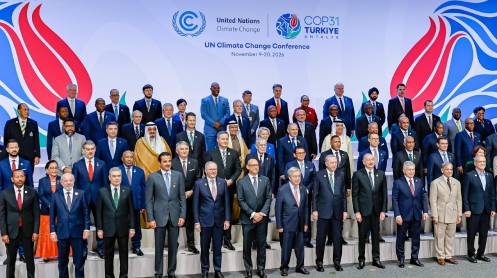
ANTALYA: The United Nations climate chief has urged world leaders attending COP31 in Antalya, Türkiye, to accelerate climate action, warning that dependence on fossil fuels is increasing economic pressures, fuelling inflation and undermining energy security.
Thank you for reading this post, don't forget to subscribe!Addressing the High-Level Segment for Heads of State and Government on November 11, the UN climate chief said climate action could help ease economic pressures by strengthening energy security, stabilising economies and protecting countries from volatile fossil fuel markets.
“The political costs of fossil fuel dependency are unforgiving. Climate action can help relieve the pressure,” the climate chief told world leaders.
The official highlighted progress achieved through international climate cooperation, noting that projected global temperature rise had declined from well over 4°C to approximately 2.6°C. Cooperation has also helped bring climate adaptation into mainstream policymaking and accelerate the global energy transition, with investment in clean energy now exceeding investment in fossil fuels.
However, the UN climate chief cautioned that global efforts remain insufficient to meet scientific requirements and that the benefits of climate action are not being shared equally. The most vulnerable countries, which have contributed least to the climate crisis, require substantially greater financial and technical support.
The address also highlighted the growing economic consequences of climate change and instability in global energy markets, including rising inflation, pressure on government budgets, higher household energy bills and declining living standards.
Emphasising the economic benefits of the transition, the climate chief said clean energy could provide more secure and stable energy supplies, while investment in disaster resilience could protect communities and strengthen global supply chains.
The official urged countries to translate existing international commitments and national climate action plans into practical solutions, focusing on economy-wide electrification, tripling adaptation finance and improving access to climate funding without reopening previously agreed commitments.
COP31 will pursue progress through two parallel tracks: formal negotiations and the Global Climate Action Agenda, aimed at bringing governments, businesses and other economic stakeholders closer to the climate process.
The UN climate chief called on national leaders to ensure that the Antalya summit delivers both a strong negotiated outcome and meaningful results under the Global Climate Action Agenda.
Meanwhile, COP31 President Murat Kurum called for a forward-looking approach to climate governance, emphasising the need to transform national climate targets into investment programmes, improve access to climate finance and place resilience at the centre of development policies.
In his November 11 address to heads of state and government, Kurum said climate change was increasingly interconnected with energy security, industrial competitiveness, agriculture, water resources, food security and national development.
He reaffirmed the importance of the 1.5°C temperature goal, warning that the world was already experiencing increasingly severe climate-related disasters, including floods, landslides and rising sea levels.
Kurum highlighted Türkiye’s experience in rebuilding earthquake-affected regions, stating that 455,000 homes had been handed over to citizens following the devastating February 2023 earthquakes. He said the experience demonstrated the importance of strengthening resilience before disasters strike.
Outlining Türkiye’s priorities under its COP31 Presidency, Kurum introduced three key areas of action.
The first focuses on translating national climate targets into investment programmes that generate employment, advance technology, strengthen production and support economic growth. He also highlighted the 35-by-35 Global Electrification Commitment, which aims to increase electricity’s share of final energy consumption to 35% by 2035.
The second priority is improving access to climate finance through faster and more effective funding mechanisms. Kurum announced the Climate Implementation Bridge, an initiative designed to connect national climate plans with projects, financing, technology and expertise.
The third priority centres on strengthening climate resilience across cities, water resources, agricultural systems and critical infrastructure to better prepare countries for future climate risks.
Kurum stressed that climate justice must underpin all climate efforts, ensuring that developing and vulnerable countries receive appropriate access to finance and technology while retaining their right to development.
He also called for greater international cooperation, arguing that climate-related challenges such as water scarcity, food insecurity and natural disasters transcend national borders and require collective solutions.
Concluding his address, the COP31 President urged world leaders to turn political commitments into practical action, saying that decisions taken in Antalya should deliver lasting benefits for future generations.
“Let Antalya stand as the city where promises turn into action,” he said.