
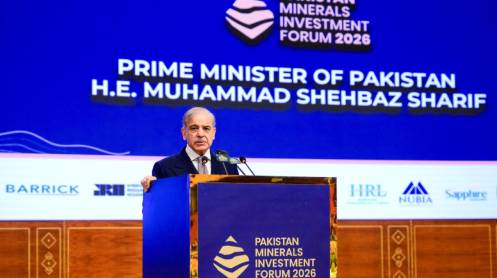
ISLAMABAD: Prime Minister Shehbaz Sharif has urged international mining companies to invest in mineral processing, refining and manufacturing facilities in Pakistan, emphasising the need to develop an integrated industrial ecosystem to maximise economic returns from the country’s vast mineral resources.
Thank you for reading this post, don't forget to subscribe!Addressing the Pakistan Minerals Investment Forum 2026 (PMIF26), the prime minister called on international investors to adopt a comprehensive approach to mineral development by extracting, processing and manufacturing resources locally before exporting finished products to global markets.
“Mine in Pakistan, process in Pakistan, manufacture in Pakistan and then export to the rest of the world,” he said, reaffirming the government’s commitment to ending the export of unprocessed minerals.
He said major mining ventures, particularly the Reko Diq copper and gold project in Balochistan, should provide the foundation for developing downstream industries, including refineries, smelters and manufacturing facilities for cables and electrical conductors.
Such investments, he added, would generate employment, strengthen domestic supply chains, promote industrialisation and expand Pakistan’s manufacturing capacity.
Highlighting the significance of Reko Diq, located on the Tethyan Copper Belt, the prime minister described it as one of the world’s largest undeveloped copper and gold deposits. He said the project was progressing towards operations, with commercial production expected to commence in 2028 following nearly two decades of delays.
Acknowledging the challenges faced by international investors, Shehbaz Sharif identified security concerns, infrastructure deficiencies and bureaucratic hurdles as key issues requiring attention to create a favourable investment environment.
He said investors expected transparent regulations, a level playing field, consistency in government policies, timely decision-making and strong institutions. The government, he added, was working to simplify procedures, eliminate unnecessary red tape and accelerate investment approvals.
The prime minister also assured investors of transparency in the allocation of mining licences and contracts, inviting them to bring cases involving delayed approvals directly to his attention. He said he would personally intervene to resolve bureaucratic obstacles affecting investment projects.
To improve access to geological information, he highlighted the establishment of the National Mineral Data Cell and the digitisation of geological records, saying these initiatives would enable investors to assess Pakistan’s mineral potential and make informed decisions before committing resources to exploration and development.
On security, Shehbaz Sharif said protecting investors, company personnel, assets and transportation routes was a fundamental responsibility of the government. Federal and provincial authorities, he assured, would work together to provide comprehensive security for mining operations and related investments.
“Your safety is our safety, and your protection is our protection,” he said.
He further stressed that large-scale mining operations required reliable supporting infrastructure, including electricity, water supplies, roads, railways and communications networks, to facilitate industrial operations and the transportation of minerals and finished products.
Emphasising environmental sustainability, the prime minister said mining activities must comply with international environmental standards and incorporate modern technologies to minimise ecological damage. He particularly underlined the need to protect water resources and ensure occupational health and safety for workers.
The prime minister also highlighted the importance of local communities in the success of mining projects, saying people living in mineral-rich regions must become direct beneficiaries of resource development.
He urged international mining companies to establish vocational training centres, facilitate technology transfer, develop local suppliers and invest in education, healthcare and access to clean drinking water.
According to him, mining projects should generate tangible economic and social benefits through employment opportunities, local business development and improved public services.
Shehbaz Sharif also pointed to Pakistan’s young population as a major potential source of skilled manpower for the expanding mining, processing and manufacturing industries, stressing the need for appropriate training and professional development.
The two-day Pakistan Minerals Investment Forum 2026, which commenced on Thursday in Islamabad, has brought together government representatives, international investors, mining executives and industry experts to explore investment opportunities and partnerships in Pakistan’s mineral sector.
The government’s broader objective is to transform the country’s largely untapped mineral reserves into a sustainable engine of economic growth by attracting foreign investment, expanding domestic processing capabilities and developing a competitive mineral-based industrial sector.