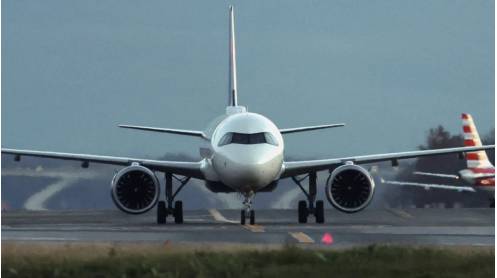
WASHINGTON: The US Federal Aviation Administration (FAA) has lifted a nationwide ground stop following a major communications failure at air traffic control centres that disrupted operations at airports across the country, resulting in thousands of flight cancellations and delays.
Thank you for reading this post, don't forget to subscribe!Transportation Secretary Sean Duffy announced that US airspace reopened at 8:15 p.m. Eastern Time on Friday (0115 GMT Saturday), but cautioned that flight departures would resume gradually and airlines would need time to restore normal operations.
“It’s going to be slow,” Duffy told reporters at the White House, warning that the disruption could continue to affect passengers for several days.
According to FlightRadar24, more than 6,600 flights had been cancelled and 8,600 delayed, while another 1,500 cancellations had already been recorded for Sunday. Tens of thousands of passengers were left stranded at airports nationwide.
Aviation analysts warned that the four-hour nationwide grounding could have a cascading impact on airline schedules, aircraft positioning and crew availability over the coming days.
Duffy said the technical failure began at 3:36 p.m. when air traffic control centres experienced instability in their radar and communications systems. The disruption was linked to overloaded network switches and routers that generated inconsistent data, prompting authorities to halt flight departures as a precaution.
He maintained that radar and communications were never completely lost and that air traffic controllers were able to land thousands of aircraft safely during the incident.
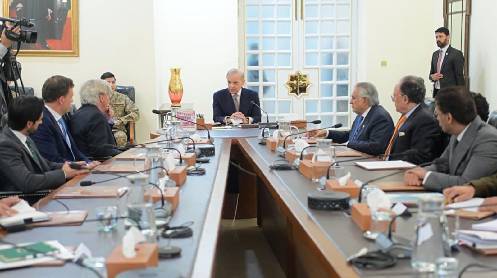
The transportation secretary said the immediate technical problem had been resolved and flying was safe to resume. However, he acknowledged that the incident exposed serious weaknesses in the country’s ageing air traffic control infrastructure.
Calling for a major modernisation programme, Duffy urged Congress to approve $50 billion to upgrade the system, arguing that outdated technology and inadequate infrastructure were increasing the risk of similar disruptions.
He also blamed insufficient congressional funding for delays in replacing the existing system. Earlier on Friday, the White House and the Department of Transportation had urged lawmakers to approve $30.1 billion for improvements to airports and air traffic control infrastructure.
Meanwhile, Homeland Security Secretary Markwayne Mullin said there was no evidence so far that the disruption had resulted from a cyberattack or a rogue artificial intelligence system, although investigators had not ruled out either possibility.
“It appears this was mechanically driven, however, we’re still looking,” Mullin said.
The National Security Agency was assisting the Department of Homeland Security in investigating the incident.
Two airline officials indicated that the outage appeared to have affected a telecommunications network operated by L3Harris Technologies. The network supports critical radio frequencies used by air traffic controllers to communicate with pilots. The company did not immediately respond to requests for comment.
Despite the lifting of the ground stop, airport operations remained severely disrupted, with passengers facing long queues, cancellations and overnight delays at major airports from Boston and New York to Los Angeles and Seattle.
Several travellers reported being forced to spend the night at airports after their flights were cancelled or rescheduled.
The disruption also raised concerns about the financial impact on US airlines. Shares of American Airlines, United Airlines and Delta Air Lines declined between 1% and 2% in after-hours trading, while JetBlue Airways fell approximately 3%.
American Airlines said it was prioritising services to smaller cities outside its major hubs, along with international destinations, to reposition aircraft and crews and accelerate the recovery of its operations.
US airlines will not be required to compensate stranded passengers for the disruption because the cancellations resulted from an FAA system failure rather than circumstances under their control.
The incident marks the most significant nationwide aviation shutdown in the United States since the September 11, 2001 attacks. The only other nationwide ground stop since then occurred in January 2023, when the FAA suspended domestic departures for approximately 90 minutes following a separate system disruption.
The latest failure has renewed concerns over the reliability of America’s air traffic control infrastructure, highlighting the urgent need for technological upgrades and stronger communications networks to safeguard one of the world’s busiest aviation systems.
By Reuters