ANTALYA: Pakistani parliamentarians and government officials have urged the international community to replace debt-based climate financing with grants, arguing that climate-vulnerable and debt-stressed countries cannot fulfil their climate commitments while a substantial portion of their revenues is consumed by debt servicing.
Thank you for reading this post, don't forget to subscribe!The demand was raised during a session titled “Adapting Under Austerity: Delivering Paris Commitments in Debt-Stressed, Climate-Vulnerable Economies: A Parliamentary Perspective” at the Pakistan Pavilion during the COP31 UN Climate Change Conference in Antalya, Türkiye.
Organised by the Parliamentary Forum on Energy and Economy in collaboration with the Asian Peoples’ Movement on Debt and Development (APMDD), the session brought together parliamentarians, policymakers and climate experts from Pakistan and other climate-vulnerable countries to discuss the financial challenges of climate adaptation and recovery.
Federal Minister for Climate Change and Environmental Coordination Dr Musadik Masood Malik, who attended as the guest of honour, criticised the global climate finance system, stating that financial assistance to developing countries had declined by 23% in a single year, returning to 2015 levels, despite international discussions about tripling climate finance.
Describing Pakistan’s position on debt-based financing, he said instruments such as green sukuk, blended finance and green bonds were also debt instruments, adding that the country could not afford further borrowing for climate recovery.
He pointed out that out of Pakistan’s total revenue collection of Rs16 trillion, approximately Rs8 trillion was spent on debt servicing, significantly limiting the resources available for development and climate action.
Referring to the devastating 2022 floods, Dr Malik said reconstruction costs amounted to approximately 9% of the country’s GDP, while the international response largely consisted of $8 billion to $10 billion in repurposed loans originally intended for sectors such as health and education.
He further highlighted the human cost of successive climate disasters, stating that the last five floods had resulted in around 6,000 deaths, left 20,000 people injured or disabled and affected or displaced approximately 40 million people.
The minister also questioned the distribution of international climate finance, arguing that financial assistance was not reaching the countries and communities most vulnerable to climate impacts.
He said that ten countries accounted for 70% of global greenhouse gas emissions but received 80% of green finance, suggesting that international financing was following emissions rather than vulnerability.
On the Loss and Damage Fund, Dr Malik noted that $822 million had been pledged, of which $422 million had been collected, but argued that affected communities had yet to receive meaningful financial support.
Despite these challenges, he highlighted Pakistan’s progress in renewable energy, saying citizens and farmers had installed an estimated 33 to 37 gigawatts of rooftop solar capacity. Clean energy sources now accounted for approximately 55% of the country’s energy mix, with a government target of increasing this share to 70% to 75% in the coming years.
Opening the session, Member of the National Assembly and Forum Co-Convenor Dr Nafisa Shah stressed that parliaments must play a central role in climate financing decisions, as legislators approve national budgets, oversee public expenditure and represent the concerns of affected communities.
She recalled that the 2022 floods affected approximately 33 million people and caused more than $30 billion in economic losses, with much of the subsequent reconstruction financed through borrowing.
She described the situation as a climate-debt trap, arguing that communities that contributed minimally to the climate crisis were being forced to rebuild their lives through additional debt.
Dr Shah called for alternative financing mechanisms, including grants, concessional finance, climate-resilient debt clauses, debt swaps, the rechanneling of Special Drawing Rights (SDRs), guarantees and improved access to the Loss and Damage Fund.
Minister of State for Climate Change Dr Shezra Mansab Ali Khan Kharal highlighted Pakistan’s progress in strengthening climate resilience and early-warning systems.
She said that, with support from the United Nations Development Programme (UNDP), 284 early-warning stations had been established to protect approximately 700,000 people in Gilgit-Baltistan and Khyber Pakhtunkhwa.
In Sindh, she added, more than one million climate-resilient homes had been completed for flood-affected families, with ownership rights granted to women. She emphasised that future climate financing must also provide resources for maintaining these systems and ensuring their long-term effectiveness.
Dr Kharal further noted that the federal Climate Budget Statement had mapped more than 5,000 cost centres for climate-related expenditure, adding that parliament should be able to track each programme from its initial budget allocation to measurable results.
She stressed that grant-based financing was particularly important for climate adaptation and loss and damage initiatives.
Danyal Chaudhry, MNA, Parliamentary Secretary for Information and Broadcasting and Secretary of the Forum, said legislators had an important responsibility to ensure that international climate commitments were translated into national legislation and budgetary allocations.
He emphasised that climate financing should not increase the debt vulnerabilities of countries already facing significant fiscal pressures.
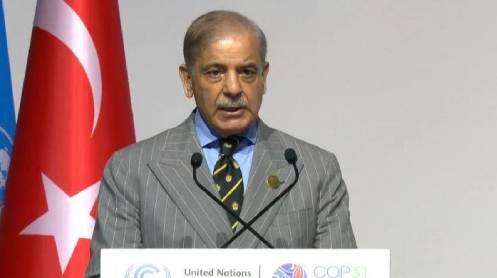
The parliamentary call for grant-based climate finance follows a similar appeal by Prime Minister Shehbaz Sharif at COP31 last week. Addressing a high-level session in Antalya, the prime minister urged the international community to increase financial support for climate resilience and adaptation without adding to the debt burden of vulnerable developing countries.
He called for greater international solidarity, timely financial assistance and grant-based funding, including through public-private partnerships, stressing that increased investment in resilience and adaptation was essential for the survival of climate-vulnerable economies.