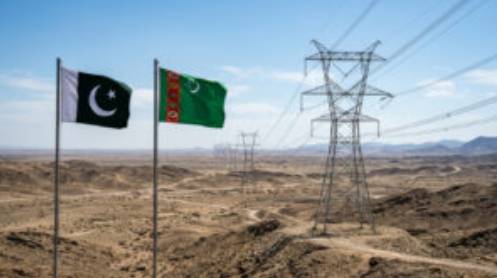
ISLAMABAD: Pakistan has invited Turkmenistan to join the Central Asia-South Asia (CASA-1,000) electricity transmission project and is pushing for the expansion of its regional power network to Uzbekistan and Turkmenistan to strengthen energy connectivity and secure additional electricity supplies.
Thank you for reading this post, don't forget to subscribe!Islamabad has already backed proposals by Tajikistan and Kyrgyzstan to explore extending the CASA-1,000 transmission network to the two countries, potentially creating a broader regional electricity market.
The project is designed to transmit up to 1,300 megawatts (MW) of electricity, primarily during the summer months, with 1,000 MW allocated to Pakistan and 300 MW to Afghanistan. Tajikistan and Kyrgyzstan are the other key partners in the initiative.
The transmission network will pass through Afghanistan, where construction activities resumed in December 2024. According to a World Bank update issued in January 2026, infrastructure development in Pakistan, Kyrgyzstan and Tajikistan has largely been completed, while Afghanistan remains the critical missing link.
During a meeting on Monday, Federal Minister for Power Division Awais Ahmad Khan Leghari invited Turkmenistan’s Minister of Energy Annageldi Saparov to join CASA-1,000. The two sides held detailed discussions on bilateral energy cooperation, regional grid connectivity and progress on the Turkmenistan-Afghanistan-Pakistan (TAP) power transmission project.
Leghari said Pakistan had encouraged Tajikistan and Kyrgyzstan to examine the possibility of extending the CASA-1,000 transmission line to Uzbekistan and Turkmenistan. He highlighted that future industrial and commercial activities in Gwadar were expected to generate substantial additional electricity demand.
He also proposed that Iran and Turkmenistan explore the possibility of increasing electricity transmission capacity to Gwadar through the Iranian grid. A joint group of experts from both countries could examine the proposal and assess its technical and commercial feasibility.
The minister reaffirmed Pakistan’s commitment to regional energy market integration and affordable electricity, stressing that the economic and financial viability of projects such as TAP and CASA-1,000 would be essential to ensuring direct benefits for end-consumers.
He noted that Pakistan currently had surplus power generation capacity and was moving towards a competitive electricity market. He also suggested converting CASA-1,000 from its existing one-way electricity transmission arrangement into a two-way system, enabling power exchanges between participating countries according to their requirements.
According to Leghari, such an arrangement could improve the project’s economic and financial sustainability while allowing participating countries to exchange electricity during periods of surplus and shortage.
Discussing the TAP project, the minister said seven fundamental technical datasets were required to advance the initiative. Pakistan had already provided three datasets, but the exchange of the remaining technical information from Turkmenistan needed to be expedited.
He proposed convening a meeting of technical working groups from both countries to establish a clear implementation roadmap within the next few weeks.
Turkmenistan’s Energy Minister Annageldi Saparov reiterated his country’s commitment to completing the TAP power transmission project. He said the initiative would help provide electricity to more than 300 million people across the region and noted that Turkmenistan had already completed the transmission line up to Afghanistan.
The remaining project phases and feasibility assessment will be pursued through the technical working group. These include a proposed 1,150-kilometre, 500-kilovolt transmission line from Afghanistan to Quetta, with a planned capacity of 1,200 MW.
Saparov assured the Pakistani side that the required technical data would be shared soon and said he would personally oversee efforts to resolve outstanding issues related to the project.
Both countries agreed to maintain regular online and in-person contact between their respective focal persons to address technical challenges, complete the feasibility assessment and advance implementation.
Pakistan and Turkmenistan Seek Stronger Trade and Investment Ties
Separately, Federation of Pakistan Chambers of Commerce and Industry (FPCCI) President Atif Ikram Sheikh and Chairman of the Turkmenistan Chamber of Commerce Gurdov Mergen Meretdurdyevich agreed to strengthen bilateral trade and economic relations through expanded business cooperation, investment partnerships and regular exchanges of business delegations, APP reported.
The understanding was reached during a meeting at FPCCI House, where both sides explored new opportunities for trade, investment and institutional collaboration between the business communities of the two countries.
They agreed to enhance cooperation between the FPCCI and the Turkmenistan Chamber of Commerce, with particular emphasis on developing institutional linkages, facilitating business-to-business contacts and promoting joint investment initiatives.
Story by Zafar Bhutta