
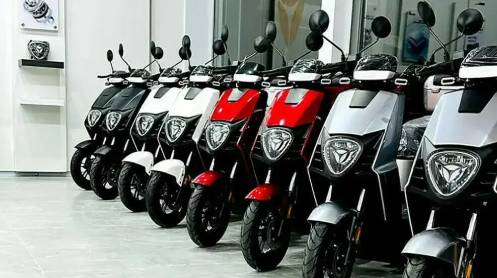
KARACHI: Pakistan’s electric motorcycle market is gaining momentum as major manufacturers accelerate the launch and production of electric two-wheelers, despite a recent decline in petrol prices and continued strong demand for conventional motorcycles.
Millat Tractors Ltd (MTL) is set to enter the electric two-wheeler market on November 29, with production already underway and dealerships designated across the country.
According to Topline Securities, MTL informed investors during a corporate briefing that it plans to introduce five lithium-ion battery-powered models, including electric bikes and scooters. Its subsidiary, Millat Industrial, will manufacture the vehicles with an annual production capacity of 250,000 units. Initially, five to six variants of electric motorcycles and scooters will be introduced.
Meanwhile, Air Link Communication Limited launched its AirV electric motorcycles on November 4, with an annual production capacity of 100,000 units at its facility in Sundar Green Special Economic Zone.
The company plans to gradually increase production and aims to import 10,000 to 15,000 units initially, with further orders depending on market response. According to Topline Securities, AirV electric bikes will be priced between Rs200,000 and Rs500,000, while the company does not intend to offer sales on credit.
The expansion comes as the conventional motorcycle market continues to demonstrate strong performance. Atlas Honda recorded its highest-ever monthly sales of 173,152 units last month, taking its cumulative sales to 643,561 units during the first four months of FY27, compared to 505,269 units in the corresponding period last year.
United Motorcycle also posted significant growth, with sales increasing to 82,474 units from 56,519 units during the same period.
Despite strong demand for petrol-powered motorcycles, electric bike manufacturers are increasingly exploring opportunities in the emerging EV market.
Motorcycle industry expert Mohammad Sabir Shaikh said manufacturers were testing their prospects in the electric vehicle segment, where prices currently range between Rs170,000 and Rs700,000.
He added that electric bike sales had exceeded 300,000 units over the past 12 months, with Punjab leading other regions in adoption, while Karachi was witnessing moderate growth.
To encourage consumers, the Punjab government has announced a subsidy of Rs50,000 for electric bike purchases, while the federal government’s Pakistan Accelerated Vehicle Electrification (PAVE) programme is offering subsidies of up to Rs80,000.
However, the Institute of Cost and Management Accountants of Pakistan (ICMAP), in its analysis titled “Can PAVE Shift Pakistan from EV Adoption to EV Industry,” has urged policymakers to focus on developing a domestic electric vehicle industry rather than relying primarily on subsidies for vehicle purchases.
The analysis argues that Pakistan’s transition towards electric mobility must go beyond subsidising consumers and prioritise local manufacturing, technology development and investment in batteries and related components. Otherwise, the country risks replacing its dependence on imported petroleum with reliance on imported electric vehicles, batteries and associated technologies.
Under the New Energy Vehicle (NEV) Policy 2025-30, the PAVE programme aims to accelerate electric mobility through subsidies, financing facilities and vehicle distribution. Its first two phases envisage the distribution of approximately 116,000 electric motorcycles.
ICMAP emphasised that PAVE should be treated as a strategic economic instrument connecting energy security, household affordability and industrial competitiveness rather than merely a vehicle subsidy scheme.
The analysis also highlighted significant implementation challenges, particularly the gap between consumer demand and actual vehicle distribution.
During the programme’s initial phase, banks received 44,689 applications by May 31 but processed only 9,889, representing approximately 22 per cent of the total. Only 4,075 applications, or around 9 per cent, were approved, while 34,800 applications, equivalent to 78 per cent, remained unprocessed.
Financing disbursed at that stage amounted to Rs143 million, while 5,409 vehicles had reportedly been distributed.
ICMAP further noted that fluctuations in international petroleum prices, import costs and foreign exchange pressures continue to expose Pakistan’s economy to external vulnerabilities, reinforcing the need to accelerate the transition towards electric mobility.
The institute stressed that developing a competitive domestic EV industry would not only reduce fuel import dependence but also create investment opportunities, generate employment and strengthen Pakistan’s industrial base.
Story by Aamir Shafaat Khan