
Nasir Shah, Zia Lanjar to lead consultations with political parties, civil society; CM assures timely local government elections
KARACHI (Nov 26): Sindh Chief Minister Syed Murad Ali Shah on Thursday announced the formation of a two-member ministerial committee, comprising Local Government Minister Syed Nasir Hussain Shah and Law Minister Ziaul Hassan Lanjar, to consult political parties, civil society and other stakeholders on further empowering local governments and developing a new local government law through collective wisdom.
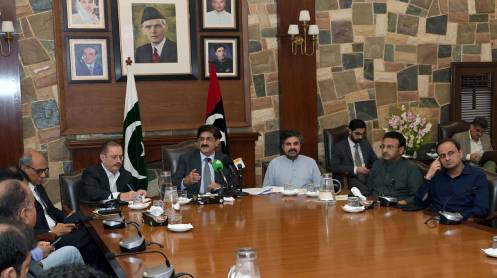
Addressing a press conference at CM House, the chief minister said the proposed consultations were aimed at strengthening local government institutions, granting them greater autonomy and improving their financial and administrative capacity in line with the Pakistan Peoples Party’s (PPP) manifesto and the vision of PPP Chairman Bilawal Bhutto Zardari.
The chief minister was accompanied by provincial ministers Sharjeel Memon, Nasir Shah, Saeed Ghani and Ziaul Hassan Lanjar, as well as Karachi Mayor Murtaza Wahab.
He said the committee would begin its work next week, engage all relevant stakeholders and submit its recommendations to the provincial government after comprehensive consultations within three months. The proposed legislation would be developed by amending the existing local government law, and the next local government elections would be held on time.
The chief minister said Sindh had consistently demonstrated its commitment to democratic local governance, holding local government elections even during challenging political and security circumstances. He recalled that in 2016, despite the controversial anti-state remarks made by an MQM leader, the provincial government proceeded with local government elections, resulting in the election of Waseem Akhtar as Karachi mayor.
Similarly, despite the devastating floods of 2022, Sindh held local government elections in 2023, ensuring continuity of the democratic process.
Referring to the PPP’s 2024 election manifesto, Mr Shah said the party had given special importance to strengthening local governments and had committed to empowering them in accordance with the Constitution and through consultation with stakeholders.
“We want to further empower local governments. How this empowerment will be structured will be decided through consultation with all stakeholders,” he said, adding that the provincial government also intended to strengthen local councils financially through the Provincial Finance Commission (PFC).
He said it was unfortunate that some provinces had failed to maintain functional local government systems while criticising Sindh, which had consistently held local government elections. He also recalled that local governments had been dissolved in a province during the tenure of the PTI-led federal government.
The chief minister urged other provinces to establish and strengthen their local government systems, saying democratic governance required effective institutions at the grassroots level.
Sindh’s position on new provinces
Responding to a question about a proposed referendum on the creation of new provinces, the chief minister said the matter had neither been discussed with him nor had he been asked to initiate any such exercise.
He said proposals for creating new provinces within Sindh’s boundaries had already been rejected by the Sindh Assembly with a two-thirds majority.
Mr Shah said the Constitution clearly provided the framework for such matters and questioned the logic of spending approximately Rs50 billion on a referendum when the ultimate constitutional and legislative decision rested with Parliament.
He explained that a constitutional provision introduced during General Ziaul Haq’s era required the National Assembly to obtain the approval of the concerned provincial assembly before a law for creating a new province could receive presidential assent.
He said the Sindh Assembly had passed its resolution to make its position clear, adding that the provincial government’s stance remained unchanged.
“Our position is clear. If people want a province, they have the right to express their aspirations, but the Sindh Assembly has already rejected the proposal to create a new province from the territory of Sindh,” he said.
Rejecting the impression that the PPP had different positions on the creation of new provinces in Sindh and other parts of the country, the chief minister clarified that the party maintained a uniform stance on Sindh, Punjab, Khyber Pakhtunkhwa and Balochistan. He said that if the people of any province wanted a change in its boundaries, the matter could be decided through a two-thirds majority vote in the respective provincial assembly.
Karachi building collapse: strict action
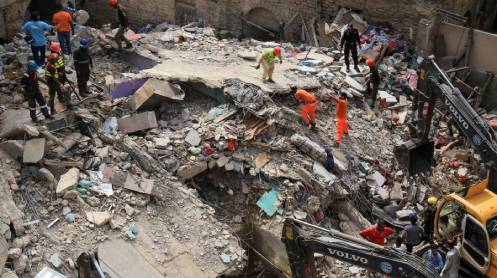
Referring to the collapse of an under-construction building near Baloch Colony in Karachi’s Administrative Society, the chief minister described the incident as deeply painful, saying the loss of precious human lives was tragic.
He said he had visited the site to review rescue and relief operations and had taken strict action against officials responsible for negligence and failure to prevent illegal construction.
He disclosed that 16 officers and officials of the Sindh Building Control Authority (SBCA) had been suspended, adding that the government intended to overhaul the authority’s functioning and reset its regulatory system.
The chief minister said 16 people had been injured in the incident, of whom three were still receiving treatment in hospital.
Murad Shah further disclosed that 123 buildings in Karachi were under construction despite court stay orders. The provincial government had requested the High Court to decide these pending cases within 15 days, while construction work on the identified buildings had been stopped in the meantime.
He said those responsible for the building collapse would not be spared and appealed to the courts not to entertain requests seeking permission to continue construction in violation of regulatory requirements.
Law & order ahead of November 29 rallies
Responding to a question about rallies planned by two political parties in Karachi on November 29, the chief minister said maintaining law and order was the government’s responsibility, and all necessary arrangements would be made.
He said the provincial government believed in political engagement and had been in contact with political parties to ensure peaceful political activities.
He recalled that a rally held on November 22 had been permitted and passed off peacefully. The government had also received an application from Qadir Magsi’s party seeking permission for a November 29 rally, after which the MQM also announced its intention to hold a rally on the same date.
To avoid any complications, the provincial government constituted a committee to meet representatives of both parties. He said the response during the committee’s meetings had been positive.
KMC jurisdiction and local government autonomy
Responding to a question about the total 30/31 per cent of Karachi is being administered by the KMC, and whether the provincial government would give it more area, the CM said that the matter should first be discussed by the ministerial committee with all relevant stakeholders.
He said the government was open to suggestions on how local governments could be made more effective and financially sustainable.
Mr Shah also observed that the local government system introduced during General Pervez Musharraf’s tenure had several structural shortcomings and was not a model the provincial government intended to replicate.
On the performance of local councils, he said it was not his role to act as a judge of their performance, as the people living in the respective areas were best placed to assess the delivery of services by their elected representatives.
Flour price fixed at Rs138 per kg
Responding to a question about the flour crisis, Mr Shah said the price of wheat flour had been fixed at Rs138 per kilogram, and the government was taking steps to ensure implementation of the notified rate.
Inquiry into ambulance explosion
Regarding an explosion involving an ambulance that claimed 10 lives, the chief minister said an inquiry had been conducted, but he was not satisfied with its findings. He had, therefore, referred the matter back for a fresh inquiry to ensure that all aspects of the incident were properly examined.
The chief minister reiterated that the provincial government was committed to accountability, institutional reforms, democratic continuity and strengthening governance at the grassroots level.