

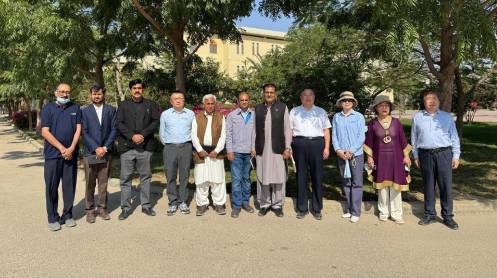
KARACHI/ TANDOJAM (Nov 27): Following Sindh Chief Minister Syed Murad Ali Shah’s recent visit to China and his initiative to strengthen Pakistan-China cooperation in water management, climate-resilient agriculture and sustainable development, Sindh Agriculture University (SAU), Tandojam, and Sino Sindh Resources (Private) Limited (SSRL), a China-Pakistan Economic Corridor (CPEC) project, have launched a joint initiative to explore the productive use of water extracted from coal mines for agriculture, land rehabilitation and ecological restoration in Thar.
The initiative reflects the Chief Minister’s vision of translating the outcomes of his China visit into practical development projects for Sindh, particularly through the application of Chinese technology, scientific research and institutional collaboration to address the province’s water and agricultural challenges.
During his visit to China, the Chief Minister underscored that effective water management was a strategic priority for Sindh and called for adopting relevant Chinese expertise in water conservation, hydrological monitoring and integrated water resource management. He also emphasised that water development initiatives must protect ecological systems while enhancing agricultural productivity and safeguarding communities from the impacts of climate change.
The Chief Minister has stressed the need for timely implementation and effective follow-up of agreements reached with Chinese partners, directing relevant provincial departments to maintain coordination and translate investment commitments and cooperation proposals into tangible development initiatives. He has also reiterated the provincial government’s commitment to facilitating Chinese investment, technology transfer and joint ventures in agriculture, energy, water management and environmental sustainability.
In line with these priorities, the SAU-SSRL collaboration seeks to transform mine dewatering water into a potential resource for sustainable agriculture through scientific research, biosaline farming, innovative water management and identification of salt-tolerant plant species suited to the arid conditions of Tharparkar.
The first joint implementation meeting was held at Thar Coal Block-I in pursuance of a Memorandum of Understanding (MoU) signed between the two institutions in Shanghai, China, in October 2026. The agreement focuses on the efficient, productive and environmentally responsible utilization of water generated through coal mining operations.
An SAU delegation led by Vice Chancellor Engr. Prof. Dr Altaf Ali Siyal attended the meeting. It included Dean Faculty of Crop Production and biosaline agriculture expert Prof. Dr Inayatullah Rajpar, Engr. Dr Rahim Bux Vistro, Engr. Dr Imran Ali Lakhiar and other technical experts.
The SSRL delegation was led by Chief Executive Officer Li Jigen and included Shang Zhonghai, former president of the Henan Academy of Forestry Sciences and current vice chairman and secretary-general of the Henan Forestry Society; Prof. Wang Sen of the Central South University of Forestry and Technology and director general of the Belt and Road Initiative; and SSRL Vice Chief Executive Officer Chaudhary Abdul Qayyum.
Speaking at the meeting, Vice Chancellor Dr Altaf Ali Siyal said the initiative was in line with the broader vision of strengthening Pakistan-China scientific cooperation and promoting sustainable utilization of natural resources. He said water extracted from coal mines should not be viewed merely as an industrial management challenge, as scientific assessment and appropriate management could turn it into a valuable alternative water resource for agricultural and environmental development.
He said SAU had considerable expertise in biosaline agriculture, soil and water management, agronomy, horticulture, plant biotechnology and climate-resilient farming. He expressed confidence that collaboration between the university and SSRL would help develop practical and environmentally sustainable solutions suited to Thar’s distinctive agroecological conditions.
SSRL CEO Li Jigen outlined the company’s roadmap for translating the MoU into practical outcomes through collaborative research, technological innovation and sustainable environmental management.
Prof. Wang Sen highlighted the potential of mine dewatering water for agricultural and ecological development and briefed the delegation on SSRL’s ongoing initiatives at Thar Coal Block-I. These include the establishment of resilient grass varieties, an operational plant tissue culture laboratory and aquaculture facilities for tilapia farming.
The technical discussions focused on identifying and evaluating indigenous salt-tolerant crops, grasses, shrubs, trees and other plant species that could survive in saline and arid environments. Both sides also explored joint laboratory and field research on water quality, soil-water-plant interactions, salinity management, plant propagation, land rehabilitation and ecological restoration.
Prof. Dr Inayatullah Rajpar shared his research experience in biosaline agriculture and soil science, highlighting scientific approaches for conducting field trials, evaluating salt-tolerant plant species and developing sustainable soil and water management strategies at the mining site.
The two institutions also discussed opportunities for joint postgraduate research, co-supervision of MS and PhD scholars, faculty and student exchange programmes, specialised technical training, internships and international conferences to strengthen academic and industry linkages.
Following the meeting, the SSRL team hosted the SAU delegation on a field visit to various facilities at Thar Coal Block-I. The delegation inspected the plant tissue culture laboratory established for the mass propagation of bamboo grass and reviewed ongoing plantation, aquaculture and land reclamation activities.
The collaboration will also contribute to the Sindh government’s broader efforts to promote climate-resilient agriculture, conserve water resources, rehabilitate degraded land and create new livelihood opportunities for communities in arid regions. The proposed research will assess the suitability of mine dewatering water through comprehensive quality testing, necessary treatment and environmental safeguards before its potential use in agriculture and ecological restoration.
The initiative aims to develop a scientifically validated and replicable model of a circular water economy, under which water generated through mining operations could, subject to environmental standards, contribute to agricultural production, biodiversity conservation, land rehabilitation and sustainable livelihoods.
The partnership is expected to extend Pakistan-China cooperation under CPEC beyond energy and infrastructure into agricultural innovation, environmental sustainability and climate resilience, translating the Chief Minister’s China visit into practical cooperation and demonstrating how scientific and industrial collaboration can turn an industrial challenge into an opportunity for sustainable development in Thar.