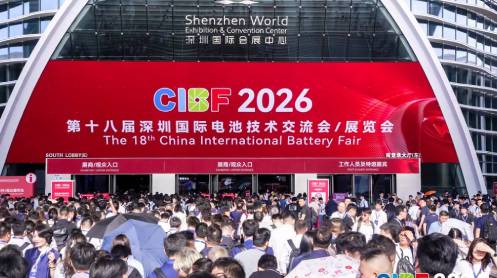
YIBIN, CHINA: The 2026 World Power Battery Conference opened on September 3 in Yibin, Sichuan Province, bringing together industry leaders, experts and international representatives to discuss the latest developments in power batteries, energy storage, battery recycling and new energy technologies.
Thank you for reading this post, don't forget to subscribe!The conference features a series of thematic sessions covering industry policies, cutting-edge technologies and innovative applications, with a strong focus on strengthening international industrial cooperation and accelerating practical collaboration across the global power battery sector.
According to data presented at the event, advances in China’s homegrown battery technologies have significantly improved performance while reducing costs. The driving range of lithium-powered batteries has increased from around 100 kilometres in the early stages of the industry to as much as 1,000 kilometres today, while charging times have been reduced from several hours to approximately 10 minutes.
Battery durability has also improved substantially, with energy-storage batteries now capable of reaching up to 1,500 charge cycles, while battery costs have fallen by around 90 percent.
Eight New Battery Technologies Unveiled
The conference also showcased eight innovative power battery technologies developed during 2025–2026. These included ultra-fast-charging batteries capable of charging in approximately 10 minutes, hybrid solid-liquid batteries with a specific energy of 350 Wh/kg, and large-capacity, high-safety energy-storage batteries ranging from 300 Ah to 600 Ah.
Industry experts said these innovations could provide further momentum to technological advancement and accelerate the adoption of electric vehicles and energy-storage systems.
Battery Safety, AI and Green Development
Ouyang Minggao, an academician of the Chinese Academy of Sciences, identified three key trends expected to shape the future of the power battery industry: full-lifecycle safety, artificial intelligence and green, low-carbon development.
China’s mandatory national standard, Electric Vehicles Traction Battery Safety Requirements, officially came into effect on July 1. The standard requires batteries to meet strict safety requirements, including preventing fires and explosions, limiting harmful gas emissions and maintaining safety performance following 300 fast-charging cycles.
Ouyang also highlighted the growing role of AI throughout the battery value chain, from intelligent battery design and manufacturing to battery management. He said AI could reshape the industry across its technology, industrial and commercial value chains.
The third major trend is the development of greener and lower-carbon battery technologies across the entire lifecycle, from raw materials and manufacturing to use and recycling.
Battery Industry and Humanoid Robotics Converge
Wang He, founder and CTO of GALBOT, discussed the company’s work in embodied intelligence and humanoid robotics at the conference.
One of GALBOT’s latest products, developed through integration with the power battery industry, has already been commercialized on a large scale by companies including CATL. Wang predicted that leading companies could achieve a “ChatGPT moment” for embodied intelligence by 2028, potentially triggering rapid growth in the humanoid robotics industry.
The increasing use of humanoid robots in manufacturing could, in turn, create new opportunities for the power battery sector.
Spain Named Guest Country of Honor
Spain was the Guest Country of Honor at this year’s conference. Betanzos, the Spanish Ambassador to China, said Chinese investment in Spain is increasingly moving beyond trade toward long-term industrial projects.
He noted that Chinese companies are establishing production facilities in Spain, creating high-quality employment opportunities and developing partnerships with local Spanish companies.
The World Power Battery Conference was launched in Yibin, Sichuan Province, in 2022. The 2026 edition marks the fifth consecutive year that Yibin has hosted the international event.