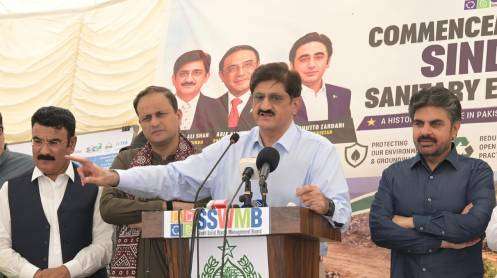
KARACHI (Oct 19): Sindh Chief Minister Syed Murad Ali Shah on Monday inaugurated the first phase of Sindh’s first sanitary engineered landfill project at Jam Chakro, marking a major step towards modernising Karachi’s solid waste management system through scientific waste disposal, environmental protection and improved waste transportation.
The Chief Minister formally inaugurated the project by cutting a ribbon and initiating waste disposal at the site. Minister for Local Government Syed Nasir Hussain Shah, l Minister for Labour Saeed Ghani, Mayor Karachi Murtaza Wahab and other senior officials were also present.
During his visit, the Chief Minister inspected the landfill site, reviewed construction progress and operational arrangements, and received a briefing from Local Government Minister Nasir Hussain Shah and Project Director Usman Muazzam.
The project, being implemented with financial and technical assistance from the World Bank, has an estimated cost of $105 million, including $100 million in World Bank financing and a $5 million contribution from the Sindh government. The overall cost was also described by the Chief Minister as approximately Rs14 billion.
The project aims to establish a modern, integrated system for waste collection, transportation and scientific disposal, reducing environmental pollution and health risks associated with conventional dumping practices.
Addressing the inauguration ceremony, the Chief Minister said the launch marked the beginning of an important phase in the transformation of Karachi’s waste management system. “We are modernising the waste collection system in Karachi and taking steps to make the entire waste management process more efficient and systematic,” he said.
He explained that conventional waste dumping could contaminate the surrounding environment and create conditions conducive to various diseases. The engineered landfill, by contrast, had been designed using specialised materials and multiple protective layers to minimise environmental damage.
The approximately 150-acre site is being developed with an engineered lining system, including geotextile materials, to protect the underlying soil from contamination. A dedicated system has also been established to collect and safely manage leachate, the liquid generated as water passes through waste.
The facility will incorporate scientific waste compaction and covering procedures, while weighbridges and environmental monitoring arrangements will help improve operational control, record-keeping and accountability.
The Chief Minister said the landfill could also offer opportunities for energy generation through the collection and utilisation of methane gas produced by decomposing waste.
“Landfill sites can generate methane, which can be collected and potentially used to produce electricity. We are looking at ways to derive environmental and economic benefits from this modern system,” he said.
Mr Shah thanked the World Bank for its financial and technical assistance, adding that international best practices would help strengthen the capacity of the Sindh Solid Waste Management Board and the Local Government Department.
Three engineered cells completed
During the briefing, the Chief Minister was informed that three engineered landfill cells had been completed, while overall progress on the construction package had reached 61.67 per cent.
The remaining construction work is targeted for completion by November 30, 2026. The Chief Minister said the facility had begun operations with the inauguration of its first phase and expressed confidence that the remaining cells would be completed according to the announced schedule.
Murad Shah directed the relevant authorities to ensure proper weighbridge operations and maintain accurate daily records of the waste received at the facility.
He also called for a regular reporting mechanism to strengthen administrative oversight, operational monitoring and accountability, emphasising that waste should be deposited only in designated engineered cells.
Four transfer stations to improve waste transportation
The Chief Minister said the engineered landfill was part of a broader initiative to improve Karachi’s waste management system, including the construction of four garbage transfer stations at Sharafi Goth, Dinga Mor, Imtiaz and Gutter Baghicha.
The four stations will have a combined handling capacity of 6,500 tonnes of waste per day. Waste collected at these facilities will be transferred to larger vehicles for transportation to the landfill site, making the process more efficient and organised.
According to Minister Local Government Syed Nasir Shah, construction of the Sharafi Goth transfer station had reached 71.43 per cent and was targeted for completion by October 30, 2026. Work on the Imtiaz station had reached 62.82 per cent, while the Gutter Baghicha station was 51.92 per cent complete. Both are scheduled for completion by November 30, 2026.
Construction of the Dinga Mor station had reached 14.11 per cent, with completion expected by March 30, 2027.
The Chief Minister said three transfer stations were progressing, while issues affecting the fourth would be addressed. He directed the concerned authorities to accelerate the work and ensure that waste collection, transportation and disposal operated as an integrated system.
He expressed confidence that the landfill and the associated transfer stations would bring a significant improvement to Karachi’s cleanliness and environmental management.
Project expected to generate $20 million in carbon credits
Highlighting the environmental and financial potential of the project, the Chief Minister said the World Bank’s technical team had estimated that the landfill initiative could generate carbon credits worth approximately $20 million.
Mr Shah said the necessary progress, including project registration for carbon credits, had been made and that the initiative could generate financial benefits alongside improvements in environmental protection.
The Chief Minister referred to Sindh’s experience in generating carbon credits through mangrove plantation in Thatta, saying the province had established practical experience in this field.
“Sindh is the only province in Pakistan benefiting from carbon credits generated through mangrove plantations in Thatta. This experience will help us explore similar opportunities through our modern waste management projects,” he said.
He added that the government wanted to use environmentally sustainable approaches to generate long-term benefits for Karachi and the province.
Additional water from Hub Dam sought for Karachi
Speaking about Karachi’s water supply, the Chief Minister said the Sindh government had remodelled the Hub Canal to improve its capacity and had requested the federal government to increase Karachi’s allocation from Hub Dam.
He said the provincial government wanted the daily allocation to be increased from 100 million gallons to 200 million gallons. “The matter is with the federal government. We have requested an additional allocation of 100 million gallons per day for Karachi, and there is capacity in Hub Dam to provide additional water,” Murad Shah said.
The CM expressed hope that federal approval would enable the provincial government to improve water availability for the city.
Rs13 billion allocated for Karachi roads
The Chief Minister announced that the Sindh government had prepared a Rs13 billion programme for the construction, rehabilitation and repair of roads across Karachi, covering major thoroughfares as well as internal roads and streets under the Karachi Metropolitan Corporation and town administrations.
He said the work was expected to begin in the first week of November and would be completed within three months.
“Insha’Allah, the condition of Karachi’s damaged roads will improve significantly by February,” he said.
He emphasised that the government was committed to addressing infrastructure problems faced by residents and ensuring that road rehabilitation was carried out within the stipulated timeframe.
The Chief Minister also expressed concern over the condition of roads damaged during utility works and directed the Local Government Commission to review how funds collected for road cutting were being utilised.
Mr Shah said the money collected for cutting roads must be spent on restoring the same roads rather than being diverted to other purposes. “People hold the local government responsible when roads are damaged and not properly restored. The funds collected for road cutting must be used for the rehabilitation of the affected roads,” he said.
The CM directed the commission to examine the utilisation of such funds by town administrations and ensure that the money was spent transparently and for its intended purpose.
Shanghai’s development offers lessons for Karachi
Referring to his recent visit to China, the Chief Minister said his delegation had travelled to the province of Hubei at the invitation of its government and had also held engagements in Shanghai.
He described the Sindh Investment and Trade Conference in Shanghai as successful and said he had observed considerable development in the city since his previous visit approximately 14 years ago. “Where investment comes in, development accelerates. We want to bring investment to Karachi by learning from Shanghai’s development experience,” he said.
Mr Shah noted that Karachi and Shanghai were sister cities and said the provincial government wanted to explore opportunities for cooperation in infrastructure, investment and urban development.
The Chief Minister said he would brief the Sindh cabinet on the outcomes of the China visit, including the discussions and agreements reached with Chinese companies and institutions. Further details would be shared with the public after the cabinet briefing.
Media Talk
Sindh Assembly’s position on new provinces
Responding to questions from the media about proposals for the creation of new provinces, the Chief Minister said the Sindh Assembly had repeatedly passed resolutions rejecting such proposals.
He said the elected representatives of Sindh had expressed the position of the province’s people through the assembly and that its resolutions could not be ignored.
Murad Ali Shah said that while everyone had the right to express an opinion, the creation of new provinces would have to follow the constitutional procedure, including the required legislative approvals and a two-thirds majority where constitutionally prescribed.
He maintained that the position adopted by the Sindh Assembly remained clear on the issue.
Calls for cooperation against terrorism
Commenting on the issue of Governor’s rule in Khyber Pakhtunkhwa, the Chief Minister said it was not a politically desirable course of action, although the Constitution provided for it under specified circumstances.
Murad Shah stressed that the federal government and all provincial governments needed to work together to address terrorism and other security challenges facing the country.
Mr Shah said threats from the eastern and western borders required a coordinated national response and close cooperation among the federation, provinces and relevant institutions.
The Chief Minister called for political dialogue to resolve differences between the federal and provincial governments, adding that cooperation against terrorism was essential for national security and stability.
He said dialogue and improved coordination could help resolve disputes and create conditions for moving forward.
Judicial commission report to be presented to cabinet
The Chief Minister told the media that the sealed report of the judicial commission would be presented at the Sindh cabinet meeting scheduled for the following day.
He said the report remained sealed and would be opened at the cabinet meeting, after which the provincial government would decide on the future course of action in accordance with the cabinet’s decision.
Thar coal, desalination and investment opportunities
Discussing the outcomes of the China visit, the Chief Minister said the delegation had held discussions with Shanghai Electric regarding investment opportunities, including a possible desalination plant.
He noted that Shanghai Electric was already involved in the Thar coal power project and referred to the electricity-generation capacity associated with Thar Coal Block-I.
He said the provincial government would present details of the investment discussions and proposed projects to the cabinet before making further information public.
The Chief Minister reiterated that the Sindh government was keen to attract investment, adopt modern technologies and use international experience to improve infrastructure, energy security, water supply and urban services across the province.
He said the Jam Chakro engineered landfill project represented an important step towards a cleaner and more environmentally sustainable Karachi, adding that the government would continue to pursue initiatives aimed at improving the quality of life for the city’s residents.
CM Murad inaugurates Sindh’s first engineered landfill site to modernise Karachi’s waste managementRs14bn World Bank-backed project to improve waste disposal; landfill initiative to generate $20m in carbon credits; CM seeks an additional 100 MGD from Hub Dam; Rs13bn released for city roads