

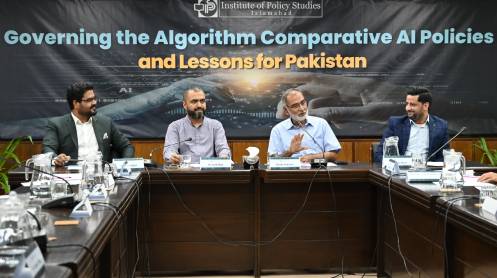
ISLAMABAD: Pakistan needs a practical, context-specific artificial intelligence (AI) governance framework that balances technological innovation with national security, data sovereignty, economic priorities, resource constraints and ethical considerations, experts said at a seminar in Islamabad.
Thank you for reading this post, don't forget to subscribe!They stressed that Pakistan must move beyond policy announcements and pilot projects towards measurable implementation, strengthen indigenous technological capabilities and ensure that AI development serves human welfare. They also highlighted the need to address AI-related challenges, including employment displacement, economic inequality, cybersecurity threats, environmental sustainability and the protection of social values.
The views were expressed at a seminar titled “Governing the Algorithm: Comparative AI Policies and Lessons for Pakistan,” organized by the Institute of Policy Studies (IPS), Islamabad. Speakers included Dr. Masood Mehmood Khan, faculty member at Curtin University, Australia; Zeeshan Javed, associate director at the Strategic Vision Institute, Islamabad; and Muhammad Faizan Fakhar, senior research associate at the Center for Aerospace and Security Studies, Islamabad. Yasir Riaz, director general of IPS, also shared his views, while Khalid Rahman, chairman of IPS, chaired the session.
Delivering the keynote address, Dr. Masood Mehmood Khan emphasized that AI policy should be developed as a comprehensive national framework integrating governance, economic priorities, digital infrastructure, research and human development. Drawing on international experiences, he outlined ten interconnected policy areas, including governance, digital infrastructure, computing capacity, research, human capital, industrial development, public services, safety and international cooperation.
He stressed that Pakistan’s progress in AI should be measured through tangible outcomes rather than policy announcements or isolated pilot projects. He recommended prioritizing high-quality datasets, expanding access to affordable computing resources, developing practical AI skills and adopting an approach suited to the country’s national requirements.
Highlighting the environmental and material dimensions of AI development, Zeeshan Javed drew attention to the growing demands for water, energy and computing infrastructure. He argued that technological indigenization should extend beyond software development to essential hardware, including graphics processing units (GPUs) and memory components. He also called for realistic assessments of Pakistan’s available resources, financial capacity, sustainability requirements and implementation timelines.
Examining international developments, Muhammad Faizan Fakhar discussed AI governance models adopted by the United States, China and the European Union, highlighting their differing strategic priorities. He observed that global competition in AI increasingly revolves around technological ecosystems, including semiconductors, computing hardware and supply chains.
He emphasized the importance of developing indigenous technological capabilities, safeguarding data sovereignty, retaining skilled professionals and independently evaluating AI systems. He also warned that reliance on foreign technologies, combined with outdated government infrastructure, could expose Pakistan to significant cybersecurity risks.
Addressing the broader socioeconomic implications, Yasir Riaz said technological transformation was inevitable and required proactive adaptation. Drawing parallels with industrialization and the emergence of the internet, he observed that AI would reshape economies and societies, while potentially displacing entry-level and middle-skilled workers.
He cautioned that the benefits of AI could remain concentrated among highly skilled segments of society, potentially widening economic inequalities and affecting existing social structures and ethical values. He also underscored the importance of reliable data systems in ensuring the accuracy and effectiveness of AI-generated outputs.
In his concluding remarks, Khalid Rahman emphasized that AI governance must be guided by an ethical framework rooted in human purpose, accountability and responsibility. Distinguishing between compliance driven by external surveillance and ethical conduct based on personal responsibility, he cautioned against allowing algorithms and data-driven systems to independently define ethical standards.
He stressed the importance of preserving moral and religious foundations while ensuring that technological advancement contributes to human welfare, sustainable development and peace rather than serving merely material interests.
The seminar concluded with a call for a proactive and coordinated national approach to AI governance, bringing together effective policymaking, indigenous technological development, institutional preparedness and a clearly defined ethical framework to ensure that Pakistan can benefit from AI while managing its associated risks.