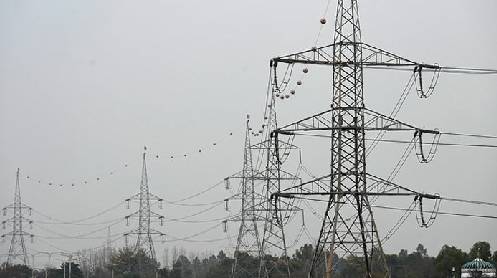
ISLAMABAD – The federal government on Monday blamed the ongoing Iran-US war and the closure of the Strait of Hormuz for the current power loadshedding.
In a press conference, Federal Minister for Energy Awais Leghari and Minister of State for Petroleum Ali Pervaiz Malik said that energy markets are facing severe challenges due to the prevailing situation in the region. The ongoing Iran-US war and the closure of the Strait of Hormuz have led to the current loadshedding. They appealed to the public to bear the hardship for a few days, saying that the government was trying to protect consumers from expensive electricity.
Awais Leghari said that load management had been carried out due to an increase in electricity demand during nighttime hours. He said the Prime Minister had issued clear instructions that electricity prices should not be increased.
The energy minister said that electricity could be generated by purchasing expensive gas from the spot market, but such a move would increase electricity prices by Rs5 to Rs6 per unit. He said that diesel- and coal-fired power plants were operational, while all the electricity that could be supplied from the northern regions was being transmitted into the national system.
Awais Leghari said that loadshedding was not necessary in several areas, including Hyderabad. However, it was continuing in areas with high levels of electricity theft. He added that people were feeling the impact of loadshedding more intensely because of the heat and humidity.
He said efforts were underway to resolve the gas issue soon, adding that attempts were being made to bring Qatar’s gas out through the Strait of Hormuz. He said the loadshedding situation would improve once the gas issue was resolved.
He said that after the provision of RLNG ended, local gas was diverted to electricity consumers. Gas was supplied to power consumers at better rates in an effort to reduce the impact of inflation.
Awais Leghari said the government understood the difficulties being faced by gas consumers and would try to provide them with relief. He thanked the relevant institutions for their support in assisting electricity consumers. He apologized to consumers facing unexpected outages and said the government was working to restore normal electricity supply.
Speaking on the occasion, Minister of State for Petroleum Ali Pervaiz Malik said that energy markets were facing severe challenges due to the situation in the region.
He said the public had been provided a subsidy of Rs130 billion on petroleum products. He added that the Ministry of Energy and the Petroleum Division had made every possible effort to ensure energy supplies.
Ali Pervaiz Malik said that the Ministry of Petroleum would play its full role in resolving the electricity and gas crises. He added that all available resources would be utilized to ensure an uninterrupted supply of energy.
He assured the energy sector that the Petroleum Division would provide full assistance in efforts to control loadshedding without imposing an excessive burden on consumers through higher electricity tariffs.
He said that if there was a need to procure LNG on an emergency basis or from the spot market, the Petroleum Division would make every possible effort to facilitate supplies and minimise the difficulties faced by the public.
Malik said both the Petroleum Division and the Ministry of Energy had worked extensively to secure LNG supplies to the greatest possible extent.
He said LNG supplies from Qatar had been halted after its production facilities were affected, adding that Qatar had suspended its LNG supplies globally. This situation had consequently created additional challenges for Pakistan’s gas supply, he added.
The minister thanked Qatar’s Minister for Oil and Gas, saying that despite the prevailing circumstances, Qatar had managed to provide Pakistan with six to seven LNG cargoes at the lowest possible prices whenever possible.
Malik also expressed gratitude to Iran for extending facilitation to Pakistan while taking the country’s energy requirements into account. He said other countries and international partners had also offered support, for which Pakistan was thankful.
He said Pakistan had been compelled to procure several LNG cargoes from the spot market while remaining mindful of its available foreign exchange resources. Some of these spot-market cargoes, he added, had cost almost twice as much as LNG supplied by Qatar.