
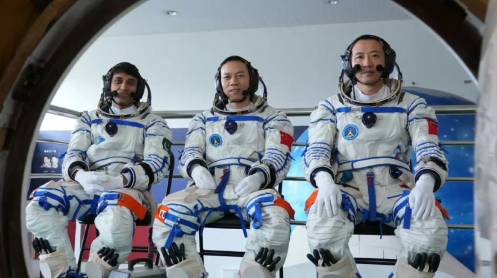
BEIJING: Pakistan’s first astronaut, 40-year-old Zeeshan Ali, has made history by entering orbit aboard China’s Shenzhou-24 spacecraft, which successfully docked with the Tiangong space station on Wednesday, marking a major milestone in Pakistan’s space programme and Pakistan-China cooperation.
The China Manned Space Agency (CMSA) confirmed that the spacecraft docked with the space station three hours and 38 minutes after its launch from the Jiuquan Satellite Launch Centre.
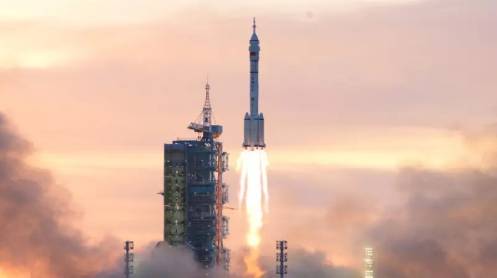
The spacecraft was launched aboard a Long March 2-F rocket at 8:18am Beijing time (5:18am Pakistan time). Approximately 10 minutes after liftoff, it successfully separated from the carrier rocket and entered its designated orbit.
The CMSA subsequently declared the launch mission a complete success, confirming that the spacecraft was functioning normally.
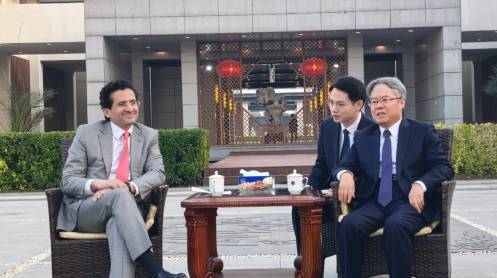
Planning Minister Ahsan Iqbal, who is visiting China, witnessed the astronauts’ send-off ceremony and the historic launch.
In a message on social media platform X, Iqbal described the mission as the beginning of a new era for Pakistan’s space programme, saying that the Pakistani flag had entered orbit with Ali, carrying the hopes and aspirations of millions of Pakistanis.
He termed the mission Pakistan’s first major flight into space and highlighted the role of Pakistan-China friendship and the China-Pakistan Economic Corridor (CPEC) in strengthening technological cooperation.
Ali is serving as a payload specialist alongside Chinese astronauts Tang Hongbo, who is commanding the mission, and Wu Yi, the mission pilot.
Following its successful docking, Ali also became the first foreign national to board China’s Tiangong space station.
He is expected to spend approximately one week in orbit, conducting scientific experiments with the Chinese crew. According to Pakistan’s Space and Upper Atmosphere Research Commission (Suparco), his research activities include cultivating microalgae as a potential source of food and oxygen for future space missions and studying the effects of spaceflight on quinoa seeds.
The CMSA said the crew would undertake around 90 experiments during the mission, alongside routine space station maintenance, scientific research and an orbital crew rotation involving astronauts from the Shenzhou-23 mission.
Carrying Pakistan’s hopes into space
Ali and fellow Pakistani candidate Khurram Daud were selected in April to undergo astronaut training in China. Their selection followed a cooperation agreement signed between Suparco and the CMSA in February 2025, under which two Pakistani candidates were to receive training, with one eventually joining a Chinese space mission.
Ali was subsequently selected for the Shenzhou-24 mission.
Speaking at a press briefing in Jiayuguan on Tuesday, he expressed gratitude to the Chinese government for helping Pakistan realise its ambition of sending an astronaut into space.
He said he had arrived at the Astronaut Centre of China carrying the hopes of millions of Pakistanis and believed that the opportunities emerging after the mission would be even more significant than the flight itself.
Ali expressed hope that Pakistan-China space cooperation would expand from a single astronaut and mission to multiple joint flights and future exploration of the Moon, Mars and beyond.
Addressing the people of Pakistan, he said he was not travelling for himself but carrying the country’s name and the aspirations of its people.
He also encouraged young Pakistanis to look towards the sky and believe that their dreams could become reality.
China’s Tiangong space station
China’s independently developed Tiangong space station, whose name means Celestial Palace, has been fully operational since late 2022. It can accommodate up to six astronauts during crew handovers, when incoming and outgoing three-member teams overlap.
The Shenzhou-24 mission also involves an unusual crew arrangement, with Shenzhou-23 commander Zhu Yangzhu remaining aboard the station to support research into the effects of long-duration spaceflight on the human body.
Zhu is expected to stay in orbit for approximately one year, potentially setting a new record for the longest single spaceflight by a Chinese astronaut. The remaining Shenzhou-23 crew members will return to Earth alongside the departing astronauts.
China has invested billions of dollars in its space programme and aims to land astronauts on the Moon before 2030, competing with the United States and its Artemis programme.
Ali’s historic journey is expected to open new opportunities for Pakistan in human spaceflight, scientific research, astronaut training and international space cooperation.