ISLAMABAD: Pakistan’s nuclear electricity production rose 3.7 per cent to a record 22.5 terawatt-hours (TWh) in 2025, while solar generation expanded at a significantly faster pace, surpassing nuclear power output for the first time.
Thank you for reading this post, don't forget to subscribe!According to the World Nuclear Industry Status Report (WNISR) 2026, nuclear electricity generation increased from 21.7 TWh in 2024 to 22.5 TWh in 2025, marking a new all-time high.
The report said solar power generation reached 36.3 TWh in 2025, exceeding nuclear output by a wide margin, although it noted that the solar figure was likely significantly underestimated due to the rapid growth of private and unregistered solar installations.
Pakistan currently operates six nuclear reactors with a combined capacity of 3,262 megawatts (MW). All six reactors were constructed by China National Nuclear Corporation (CNNC), including the 1,200MW Hualong One units K-2 and K-3 at the Karachi Nuclear Power Generating Station and four reactors at the Chashma Nuclear Power Generating Station.
The report noted that debt repayment accounts for a significant portion of the cost of nuclear electricity in Pakistan, particularly for the recently commissioned K-2 and K-3 reactors, which entered commercial operation in 2022 and 2023, respectively.
Citing the Pakistan Economic Survey 2025-26, the WNISR said the debt repayment period for the reactors was 12 years, representing only around 20 per cent of their estimated 60-year economic lifetime.
The Karachi site also houses the 90MW K-1 reactor, a CANDU unit that was permanently shut down in 2021 after around five decades of operation.
At Chashma, four operating reactors — C-1 to C-4 — have a combined capacity of 1,230MW. CNNC is also constructing the 1,000MW C-5 reactor at the site.
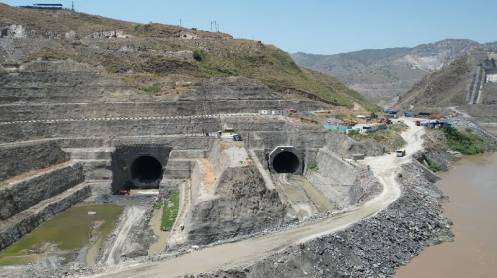
Although the agreement for C-5 dates back to 2017, formal construction took several years to begin. The first concrete was poured for the reactor building’s base slab on December 30, 2024. The project is expected to be completed by 2030 and represents China’s only ongoing nuclear new-build project outside the country.
The report also highlighted Pakistan’s rapid expansion of solar power, saying official generation figures did not fully capture the scale of the country’s solar deployment. A decline in grid electricity consumption despite economic growth was partly attributed to the growing use of privately installed solar systems for self-consumption.
Pakistan imported more than 58GW of solar panels from China between the beginning of 2017 and mid-2026. Around 40GW, or 69 per cent, of these imports occurred during the two-and-a-half-year period from 2024 to mid-2026.
The surge has made Pakistan the second-largest single-country market for Chinese solar panel exports after the Netherlands, which serves largely as a European distribution hub.
The WNISR said Pakistan had installed roughly twice as much solar capacity in five years as France had installed over a decade. In 2025, Pakistan was China’s largest customer for solar panels, while by the summer of that year solar power had become the country’s single largest source of electricity.
Globally, the United States remained the largest nuclear power producer by operating capacity, with 94 reactors and 96,952MW, followed by France with 57 reactors and 63,000MW and China with 63 reactors and 61,521MW. Russia ranked fourth with 34 reactors and 27,969MW.
The figures highlight a rapidly changing electricity mix in Pakistan, where nuclear generation continues to reach record levels while the rapid expansion of solar — much of it outside the traditional grid — is reshaping the country’s power sector.
Story by Khaleeq Kiani