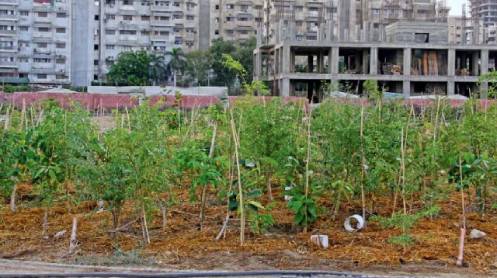
KARACHI: In a bid to restore greenery and strengthen urban biodiversity, a five-acre urban forest featuring 5,150 trees and plants has been established at the Sindh Governor House using Japan’s Miyawaki plantation technique.
Named Quaid-e-Azam Forest, the project aims to improve air quality, moderate urban temperatures and create habitats for birds, butterflies and other wildlife amid Karachi’s shrinking green cover and rising exposure to extreme heat.
According to Dr Saifur Rehman, Principal Secretary to the Governor House, the forest was established on the special instructions of Governor Nihal Hashmi and named in honour of Pakistan’s founder, Quaid-e-Azam Muhammad Ali Jinnah, to mark his 150th birth anniversary.
He said priority had been given to indigenous and climate-suitable species, including neem, gulmohar, tamarind, jamun, mulberry, moringa, ber, mango, guava and lemon, alongside flowering and shade-providing trees.
Dr Saifur Rehman emphasised that the initiative should be replicated across Karachi through plantations in residential neighbourhoods, educational institutions, parks, government-owned land and other available spaces.
He stressed that trees should be treated as an essential part of urban life rather than merely decorative features, adding that regular watering, care and maintenance were crucial to ensuring the long-term survival of plantation projects.
Highlighting the ecological consequences of shrinking green spaces, he said the loss of trees had contributed to the disappearance of familiar birdlife, including parrots, bulbuls, mynas and sparrows, from many neighbourhoods. Children, too, were becoming increasingly disconnected from nature and urban wildlife.
The Miyawaki technique involves planting multiple tree species closely together in a limited area to encourage dense vegetation. With suitable soil, adequate water and proper maintenance, the method can help establish a green ecosystem in a relatively short period, making it suitable for densely populated cities where land is scarce.
Alongside the plantation, a digital forest mapping system is being planned to document individual trees, monitor their growth and maintain biodiversity records. The proposed system will use tools such as Google Earth, QField, QGIS and PlantNet to map locations, record GPS coordinates and assist in identifying plant species through photographs and field surveys.
The initiative aims to combine urban greening with scientific monitoring, providing a model that could support future forest restoration and biodiversity conservation efforts across Karachi.
Story by Aftab Khan