

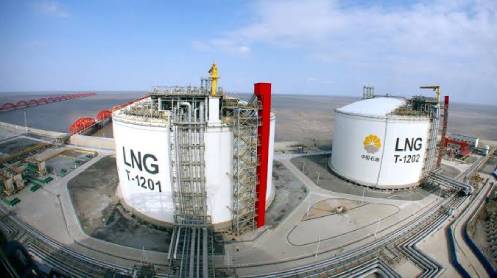
SINGAPORE: Emerging Asian countries are scaling back or delaying liquefied natural gas (LNG)-based power projects as geopolitical tensions, soaring fuel prices, equipment shortages and increasingly competitive renewable energy reshape the region’s energy plans.
Countries including Vietnam and the Philippines had planned to expand LNG import terminals and gas-fired power plants to meet rising electricity demand and reduce dependence on coal. However, the market disruptions following Russia’s 2022 invasion of Ukraine and the ongoing US-Iran conflict have driven up fuel prices, highlighting the risks of relying heavily on imported gas.
Several projects have since stalled, while others have fallen behind schedule. A global shortage of gas turbines has further constrained the development of new power plants.
Meanwhile, declining renewable energy costs are encouraging governments to accelerate solar and wind deployment to reduce exposure to imported fuel prices. The International Energy Agency forecast in October that wind and solar would account for 11 per cent of Southeast Asia’s energy mix by 2030, up from 5 per cent in 2025.
“As gas project delays mount and supply chains tighten, policymakers are being forced to rethink not only the role of gas in the near term, but also the long-term pathways to achieving their energy transition goals,” said Wei Han Tan, Southeast Asia power and renewables analyst at Wood Mackenzie.
According to the consultancy, countries may increasingly rely on existing coal-fired power plants while accelerating renewable energy deployment to meet rising electricity demand.
Wood Mackenzie estimates that only 14.9 gigawatts (GW) of Southeast Asia’s planned 53GW gas-fired power project pipeline will become operational by 2030. Vietnam faces the largest projected shortfall, with 25.7GW of planned capacity unlikely to start operating by that year.
Gas Generation Loses Ground to Renewables
Gas-fired electricity generation was already losing ground in several emerging Asian economies before the latest geopolitical crisis, according to data from energy think tank Ember.
Gas-fired power output has declined in Bangladesh, Pakistan and India over the past five years as coal and renewable energy have expanded. Gas has also struggled to increase its share of China’s electricity mix.
In Southeast Asia, gas-fired generation volumes have remained broadly stable over the past decade but have gradually lost market share as renewable capacity has increased.
Countries Accelerate Energy Transition Plans
Since the US-Israeli war on Iran began on February 28, emerging Asian markets have stepped up efforts to diversify their power supplies. Bangladesh and Thailand have announced solar deployment plans, while Vietnam is considering greater reliance on coal-fired generation.
Thailand, which imports around one-fifth of its LNG from Qatar, faces the immediate challenge of securing alternative supplies while accelerating its longer-term energy transition, the country’s energy minister told Reuters last month.
In the Philippines, rooftop solar installations are increasing as households and businesses seek relief from high electricity prices. At least three LNG-related projects in the country have also been halted over the past two years.
One project stalled after developer Energy World Corp sold the gas turbine intended for its power plant for nearly four times the price it had paid a decade earlier. The company cited the rapid growth of renewable energy, which was reducing the need for additional gas-fired generation. It now intends to develop the site as an LNG import terminal, according to its website.
Irtiza Sayyed, chief executive of JERA Global Energy Solutions, said power infrastructure development in emerging economies had slowed as energy projects competed with data centres for limited gas turbine supplies. Japan’s largest power generator is seeking to expand LNG sales in South and Southeast Asia.
LNG Demand to Rise, but Long-Term Outlook Weakens
Despite the slowdown in new projects, overall LNG demand in emerging Asia is still expected to grow as economies expand and domestic gas production declines.
Wood Mackenzie forecasts that Southeast Asia’s LNG consumption will increase to 39 million metric tonnes by 2028, from 27 million tonnes in 2025.
Supporters of LNG argue that gas remains important for grid reliability and flexible electricity generation, while the expansion of data centres could create additional power demand.
However, continued fuel price uncertainty is likely to encourage governments to prioritise renewable energy when planning their electricity systems for the next decade, said Lu Ming Pang, an analyst at Rystad Energy.
The consultancy has reduced its long-term Asian LNG demand forecasts by 3 per cent for 2040 and 7 per cent for 2045. The revisions reflect difficulties in securing adequate LNG supply agreements and infrastructure in countries such as Vietnam and the Philippines, alongside China’s accelerating renewable energy expansion.
The changing outlook highlights a growing challenge for LNG developers: although gas demand may continue to rise in the near term, renewable energy, fuel price volatility and infrastructure constraints could limit the region’s long-term dependence on imported LNG.