
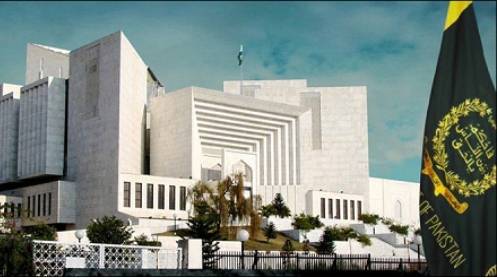
ISLAMABAD: The Supreme Court of Pakistan has called for a thorough examination of illegal electricity connections, unauthorised power distribution and the alleged involvement of utility officials in private electricity supply networks.
Thank you for reading this post, don't forget to subscribe!A two-member bench, comprising Justice Muhammad Ali Mazhar and Justice Irfan Saadat Khan, made the observations while hearing a petition seeking cancellation of bail granted to an accused in a case involving an electric shock incident caused by a broken power wire.
In a six-page order authored by Justice Muhammad Ali Mazhar, the court stressed the need to closely examine the role of individuals involved in electricity theft, unauthorised sales and private power distribution outside officially approved channels.
The court observed that it was difficult to comprehend how electricity could be supplied through unauthorised networks without the knowledge of WAPDA, concerned utility companies or their officials. It emphasised the need for a detailed review of existing practices and the possible involvement of personnel responsible for electricity distribution.
The case originated from an incident in March 2024 in Larkana, where Noor Hussain, brother of the petitioner Ali Asghar Khokhar, suffered an electric shock after a PVC wire snapped and came into contact with a high-tension electricity line.
An FIR was subsequently registered at Rehmatpur Police Station against Anwar Ali Kori and other WAPDA officials. The allegations stated that the accused were supplying electricity to shops through a privately laid connection from a disposal-phase line, reportedly in exchange for monetary payments.
The petitioner approached the Supreme Court seeking cancellation of the bail granted to Anwar Ali Kori by the Sindh High Court’s Larkana circuit bench on October 20, 2025. He argued that the high court had overlooked important facts and evidence collected during the investigation.
However, the Supreme Court noted that the high court had granted bail primarily due to a nine-month delay in registering the FIR and the nature of the allegations, which attributed negligence to the respondent. The investigating officer had also stated that the respondent had no connection with WAPDA officials.
The apex court observed that the allegations required further inquiry and that the actual role and responsibility of the accused could only be established through a full-fledged trial.
During the proceedings, the complainant stated that the respondent, allegedly working as a contractor in collusion with WAPDA officials, had been supplying electricity to his shop against payment. He also acknowledged that he had never received an electricity bill from WAPDA or any other utility company.
However, the petitioner eventually informed the court that, as the trial was still pending, he did not wish to pursue his request for cancellation of bail.
The Supreme Court consequently found no grounds to interfere with the high court’s bail order and directed its office to forward a copy of the judgment to the Chairman WAPDA for information.
The court’s observations have highlighted the need for greater oversight of electricity distribution networks and accountability of officials, particularly in cases involving alleged illegal connections and private electricity supply arrangements.
Story by Nasir Iqbal