BISHKEK: Prime Minister Shehbaz Sharif has warned that water must never be used as a weapon or instrument of political coercion, stressing that agreements governing shared water resources are binding international commitments that must be respected in letter and spirit.
Addressing the 26th Meeting of the Shanghai Cooperation Organisation (SCO) Council of Heads of State in Bishkek, the prime minister described water as the “lifeblood” of the region and said its availability was essential for sustaining millions of people, agriculture and the future of generations to come.
“The treaties governing our shared waters are binding commitments that must be honoured unconditionally both in letter and spirit,” he said while addressing the SCO Plus Format meeting, held a day after the Permanent Court of Arbitration ruled that the 1960 Indus Waters Treaty remains in force.
PM Shehbaz called for water to remain outside political disputes and stressed that adherence to international agreements was vital for regional stability and the protection of countries dependent on shared water resources.
Pakistan to Focus on Energy, AI and Connectivity
The prime minister said the SCO region, home to more than three billion people, possessed enormous economic and development potential that could be realised through greater regional cooperation.
He called for accelerated work on trans-regional connectivity, energy corridors, rail and road links, IT and artificial intelligence, poverty reduction, health, disaster management, culture and sports.
He said Pakistan’s incoming SCO chairmanship would focus on delivering tangible benefits to member states. Islamabad would prioritise IT and AI, energy, development and poverty reduction, disaster management, health, culture and sports during its tenure.
PM Shehbaz proposed the establishment of an SCO Sovereign AI Infrastructure and Governance Framework to promote responsible and inclusive AI development, strengthen digital sovereignty and ensure that no member state was left behind.
He also announced that Pakistan would host the Global Resilience Expo 2026-27 in Islamabad, aimed at strengthening regional cooperation in disaster management, early warning systems and emergency response.
The prime minister called for full implementation of the SCO Development Strategy through 2035 and said the proposed SCO Development Bank would be an important instrument for financing regional development projects.
He said Pakistan, as permanent chair of the SCO Special Working Group on Poverty Reduction, would continue working to strengthen social protection and inclusive development across the region.
Connectivity and Energy Security
PM Shehbaz stressed that recent regional crises had demonstrated the importance of secure energy routes and reliable connectivity.
He said the China-Pakistan Economic Corridor (CPEC) remained an important gateway connecting regional economies with the Arabian Sea, while Pakistan was committed to advancing trans-regional railway, road and energy projects.
He urged SCO members to work collectively to build secure energy corridors and strengthen economic integration across the region.
Peace, Terrorism and Regional Stability
The prime minister said the global environment was facing growing geopolitical tensions, economic fragmentation, climate-related crises and rapid technological change, making greater cooperation among SCO members increasingly important.
He reaffirmed Pakistan’s commitment to the UN Charter and SCO principles and said Islamabad had consistently advocated peace when the sovereignty and territorial integrity of an SCO member state was violated earlier this year.
He said the resulting regional crisis had disrupted energy supply routes and imposed significant economic costs on Pakistan and the international community.
Turning to the Middle East, PM Shehbaz expressed deep concern over the continuing suffering of Palestinians in Gaza and the West Bank and urged the international community to help secure their right to self-determination.
He also highlighted Pakistan’s sacrifices in the fight against terrorism, saying more than 90,000 people had lost their lives and the country had suffered economic losses exceeding $150 billion over the past 25 years.
As chair of the SCO Regional Anti-Terrorist Structure (RATS), he said Pakistan would continue supporting stronger regional cooperation against terrorism, separatism and religious extremism.
He stressed that regional connectivity and economic development could not be achieved without peace and stability in Afghanistan and called for an end to terrorist groups using Afghan territory to launch attacks against Pakistan and other neighbouring countries.
UN Reform and Global Peace
Addressing the SCO Plus meeting, PM Shehbaz said Pakistan, as a non-permanent member of the UN Security Council, had actively contributed to global peace efforts over the past two years.
He said the emerging multipolar world offered an opportunity to build a more equitable, democratic and just international system, but argued that the United Nations urgently required reforms to become more accountable and responsive.
Referring to Gaza and the West Bank, he called for decisive international action to end the suffering of Palestinian civilians and uphold their right to self-determination, adding that the same principle should apply to all oppressed nations.
The prime minister said Pakistan’s diplomatic efforts had contributed to the signing of the Islamabad Memorandum of Understanding, which he described as a viable pathway towards resolving the ongoing Gulf conflict through dialogue and diplomacy.
He also referred to the recently signed Makkah Joint Defence Agreement with Saudi Arabia and Türkiye, describing it as fundamentally defensive and aimed at strengthening sovereignty, territorial integrity, collective security and regional peace.
Bilateral Meetings on SCO Sidelines
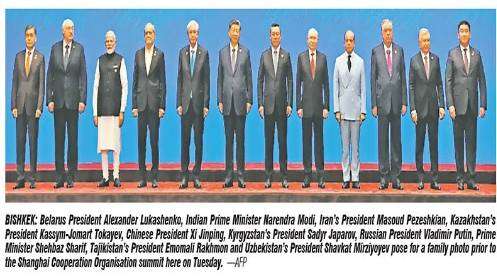
PM Shehbaz also held informal meetings with several world leaders on the sidelines of the SCO summit, including Chinese President Xi Jinping, Russian President Vladimir Putin, Turkish President Recep Tayyip Erdogan, Iranian President Masoud Pezeshkian, Belarusian President Alexander Lukashenko, Uzbek President Shavkat Mirziyoyev, Tajik President Emomali Rahmon and Kazakh President Kassym-Jomart Tokayev.
In a separate meeting, PM Shehbaz and Belarusian President Alexander Lukashenko reaffirmed their commitment to further strengthening bilateral relations.
The two leaders reviewed cooperation in political, trade, economic, defence and cultural fields and agreed to expand collaboration in trade, industry, agriculture, IT and vocational training.
PM Shehbaz also invited the Belarusian president to visit Pakistan next year as Islamabad prepares to assume the SCO chairmanship.
The prime minister signed the joint declaration of the SCO Council of Heads of State Summit and thanked Kyrgyz President Sadyr Zhaparov for hosting the meeting and for his country’s successful SCO chairmanship.
Story by Ag App