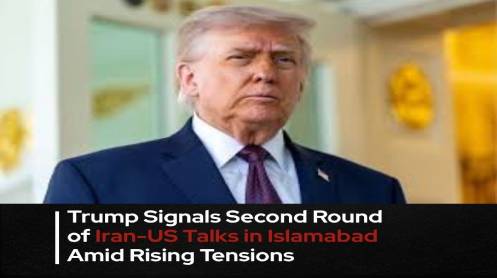
WASHINGTON/ISLAMABAD: Donald Trump has indicated that a second round of talks between the United States and Iran could take place in Islamabad within days, even as Washington intensifies military pressure through a naval blockade of Iranian ports.
In an interview with the New York Post, Trump suggested negotiations may resume in Pakistan “over the next two days,” reversing his earlier stance. He praised Asim Munir for facilitating dialogue, calling him “fantastic,” and highlighting Pakistan’s role in hosting the initial round of talks.
The first round of negotiations, mediated by Pakistan, concluded in Islamabad after nearly 21 hours without a breakthrough, though both sides agreed to keep diplomatic channels open.
Earlier, J. D. Vance, who led the US delegation, commended Prime Minister Shehbaz Sharif and Field Marshal Munir for their statesmanship and hospitality during the talks.
Meanwhile, the US military has escalated pressure on Iran by enforcing a naval blockade. The United States Central Command reported that over 10,000 troops, multiple warships, and aircraft are involved, with several vessels turned back from Iranian ports within the first 24 hours.
The blockade comes amid heightened tensions following the US-Israel military campaign launched in late February, with the strategically critical Strait of Hormuz also affected by disruptions.
Diplomatic activity has intensified in Islamabad, where Deputy Prime Minister Ishaq Dar engaged with senior officials from Turkiye, Egypt, and Saudi Arabia to promote coordinated efforts for peace and stability.
Separately, President Asif Ali Zardari lauded Pakistan’s mediation role and urged continued engagement with both Washington and Tehran to sustain the fragile diplomatic process.
Global leaders have also called for restraint. Emmanuel Macron urged the resumption of negotiations and emphasized the importance of maintaining a ceasefire and reopening key maritime routes.
China criticized the US blockade as “dangerous and irresponsible,” warning it could escalate tensions and threaten regional stability. Chinese President Xi Jinping reiterated the need for peaceful coexistence and a cooperative security framework in the Middle East.
Iranian President Masoud Pezeshkian, meanwhile, praised countries opposing Israeli actions, underscoring growing geopolitical divisions.
As tensions escalate, Pakistan continues to position itself as a key diplomatic intermediary, with further engagements planned, including Prime Minister Shehbaz Sharif’s upcoming visits to regional allies aimed at advancing peace efforts.
Story by Syed Irfan Raza in Islamabad and Anwar Iqbal in Washington also contributed to this report
With additional input from APP, AFP, Reuters