BURGENSTOCK, SWITZERLAND: The United States and Iran have agreed on a roadmap to reach a comprehensive peace agreement within 60 days following marathon negotiations in the Swiss resort of Burgenstock, according to a joint statement issued on Monday by mediators Pakistan and Qatar.
The talks, held under the framework of the Islamabad Memorandum of Understanding (MoU) signed last week, marked the first formal negotiating session since the breakthrough interim peace accord brokered with the support of Pakistan and Qatar. Prime Minister Shehbaz Sharif had signed the agreement as a mediator, paving the way for efforts to end the conflict that erupted earlier this year.
In a joint statement, Pakistan and Qatar described the discussions as positive and constructive, noting that “encouraging progress” had been achieved, including the establishment of mechanisms for continued technical negotiations.
High-Level Committee Established
Building on the Islamabad MoU, both sides agreed to establish a high-level committee that will provide political oversight of the mediation process. Chief negotiators will report regularly to the committee while leading specialized working groups on nuclear issues, sanctions, monitoring, and dispute resolution.
The committee approved a roadmap aimed at reaching a final settlement within 60 days and authorized the immediate launch of technical negotiations on outstanding issues.
To reduce tensions and prevent misunderstandings, Washington and Tehran also agreed to establish a direct communication channel for the next 60 days, focusing on maritime security and ensuring safe commercial navigation through the Strait of Hormuz.
The parties further agreed to create a deconfliction mechanism involving Iran, the United States, Lebanon, and the mediators to oversee implementation of commitments related to the cessation of military operations in Lebanon.
Technical discussions are expected to continue throughout the week at Burgenstock.
Nuclear Deal, Lebanon Ceasefire Discussed
A US official described the talks as “robust,” confirming that negotiators discussed all key elements of a potential nuclear agreement, maritime security concerns in the Strait of Hormuz, and mechanisms to sustain the ceasefire in southern Lebanon.
“We’ve had robust discussions on all elements of the nuclear deal,” the official said, adding that technical teams would continue refining proposals in the coming days.
The official also emphasized efforts to clarify Iranian positions regarding the Strait of Hormuz and develop mechanisms to prevent incidents that could threaten regional stability or global energy supplies.
Pakistan, Qatar Praised for Mediation
Soon after the joint statement was released, Iranian Foreign Minister Abbas Araghchi praised the mediation efforts of Pakistan and Qatar, saying their diplomacy had delivered significant progress toward ending the conflict.
According to Araghchi, discussions covered easing restrictions on Iran’s oil and petrochemical exports, lifting certain blockades, releasing portions of frozen Iranian assets, and launching a major reconstruction and development programme.
He described the newly established Lebanon deconfliction mechanism as the first major test of the agreement.
Opening Session Highlights
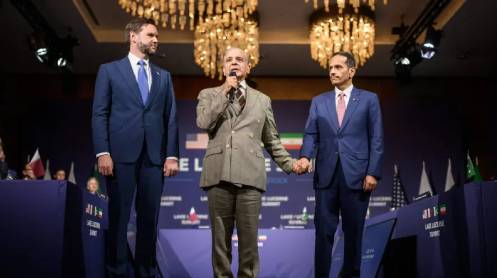
Addressing participants before the closed-door talks began, Prime Minister Shehbaz Sharif expressed optimism that the negotiations would contribute to peace, stability, and prosperity across the region and beyond.
“We are going to have productive discussions that will hopefully lead to positive results in the days ahead,” he said.
The prime minister thanked US President Donald Trump, Vice President JD Vance, and Chief of Defence Staff Field Marshal Asim Munir for their efforts in advancing the peace process.
US Vice President JD Vance described the meeting as historic and said it represented the beginning of a serious technical negotiation process between Washington and Tehran.
“Peace requires give and take,” Vance said, adding that the objective was not to resolve every disagreement immediately but to establish a framework for addressing key concerns and building a more stable future.
He reiterated Washington’s commitment to a comprehensive regional ceasefire, including in Lebanon, and stated that improved relations with Iran would be possible if Tehran permanently abandoned any ambitions to acquire nuclear weapons.
Global Significance
Qatari Prime Minister Sheikh Mohammed bin Abdulrahman Al Thani highlighted the broader implications of the talks, noting that a successful outcome would enhance not only regional security but also global economic stability.
“This is not the final celebration; it is the beginning,” he said, reaffirming Qatar’s commitment to supporting mediation efforts until a lasting settlement is achieved.
Background
The Burgenstock negotiations follow the signing of a 14-point agreement between US President Donald Trump and Iranian President Masoud Pezeshkian, witnessed by Prime Minister Shehbaz Sharif as mediator.
The agreement, which helped end more than 100 days of conflict, provides a framework for restoring stability, reopening the Strait of Hormuz, advancing nuclear negotiations, and launching further diplomatic engagement.
Under the accord, a final settlement on Iran’s nuclear programme could unlock a proposed $300 billion reconstruction and development fund supported by regional partners, while opening the door to broader normalization between Washington and Tehran.
With both sides now committed to a 60-day negotiating timetable, attention will turn to the technical talks in Switzerland, where diplomats hope to transform recent diplomatic gains into a comprehensive and lasting peace agreement.