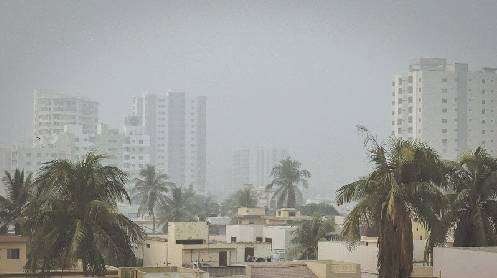
KARACHI: Environmental experts, academics, and sustainability advocates have raised serious concerns over Karachi’s worsening environmental conditions, warning that the city’s deteriorating air quality and shrinking green cover pose significant threats to public health and long-term sustainability.
The concerns were highlighted during the Climate Matters Conference, organized by the Institute of Environmental Studies (IES) at the University of Karachi’s Chinese Teachers Memorial Auditorium in connection with World Environment Day. The conference was held under the theme, “Inspired by Nature, For Climate, For Our Future.”
Speaking on the occasion, IES Director Dr. Farrakh Nawaz said Pakistan remains among the countries most vulnerable to climate change, yet public awareness and collective action remain inadequate. He described environmental pollution and climate change as critical national challenges requiring immediate attention.
“Karachi’s Air Quality Index has reached alarming levels, far exceeding World Health Organization (WHO) limits and posing serious public health risks,” he warned.
Dr. Nawaz also highlighted the city’s mounting waste management crisis, noting that Karachi generates nearly 16,000 tonnes of solid waste daily, while an estimated 450 to 600 million gallons of untreated wastewater are discharged into the sea every day.
“Without responsible waste management and environmental protection, meaningful change cannot be achieved,” he emphasized.
IES faculty member Dr. Amir Alamgir pointed out that while extensive research has established the devastating impacts of climate change, practical action remains insufficient. He expressed concern over the large-scale cutting of trees to make way for development projects and housing schemes across the city.
“Karachi is rapidly losing its green spaces. Positive behavioral change at both individual and collective levels is essential to address the climate crisis,” he said.
Highlighting the city’s shrinking vegetation cover, Mahboob Alam Khan, Head of Sustainable Operations at Meezan Bank, revealed that Karachi’s greenery has declined to only three percent, with ongoing urban expansion threatening what remains.
He called on policymakers to introduce stronger legislation and effective strategies to curb tree cutting and promote large-scale plantation initiatives.
University of Karachi Vice Chancellor Dr. Khalid Mahmood Iraqi stressed that climate change is no longer merely an environmental issue but a matter of human survival. He urged teachers, students, policymakers, and citizens alike to play an active role in environmental conservation.
“Knowledge, expertise, and research are available to address climate change. The real challenge lies in implementation,” he remarked, criticizing weak enforcement of environmental regulations despite widespread awareness of issues such as plastic pollution.
Dr. Iraqi also warned of a potential water shortage crisis in Pakistan if urgent measures are not taken to improve water conservation and environmental management.
“Our city has turned into a concrete jungle, resulting in rising temperatures, more intense heatwaves, and worsening environmental conditions,” he observed.
Representing Meezan Bank, Riaz Ahmed urged citizens to adopt environmentally responsible lifestyles and contribute to protecting the city for future generations.
“Karachi, once known as the City of Lights, is now grappling with air pollution, improper waste disposal, and environmental degradation. Environmental protection must begin at home and within our communities,” he said.
The conference also featured presentations by Dr. Hina Mudassir, Director of the Office of Research, Innovation and Commercialisation at Federal Urdu University of Arts, Science and Technology, along with representatives from various non-governmental organizations. Speakers discussed climate change risks, mitigation strategies, and the role of government, private sector, and civil society in safeguarding the environment.
The participants collectively emphasized that stronger policy implementation, public awareness, and sustainable urban planning are essential to reversing Karachi’s environmental decline and building a climate-resilient future.
Story by Faiza Ilyas