KARACHI: Sindh Chief Minister Syed Murad Ali Shah on Wednesday approved a comprehensive roadmap to promote energy efficiency and conservation across the province, directing authorities to accelerate reforms aimed at reducing electricity consumption, improving energy management, and supporting sustainable development.
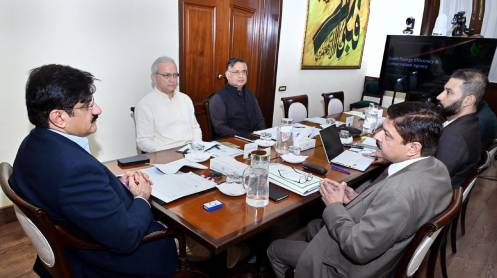
Chairing the fifth meeting of the Board of the Sindh Energy Efficiency and Conservation Agency at the Chief Minister’s House, the chief minister emphasized that energy conservation remains one of the most cost-effective and sustainable solutions to meet rising energy demand and address climate change.
The meeting was attended by Principal Secretary Agha Wasif Abbas, Energy Secretary Shoaib Ansari, Special Secretary Finance Asghar Memon, Board Member Iftikhar Ahmed, SEECA General Manager Abdul Basit Siddiqui (via video link), and the Managing Director of the National Energy Efficiency and Conservation Authority.
The board approved key amendments to the SEECA Rules 2022, framed under the NEECA Act 2016, to strengthen the agency’s governance, administrative continuity, and technical capacity. The chief minister directed officials to ensure effective implementation of energy conservation policies and programmes across government departments, industries, and households.
“Every unit of energy saved is equivalent to a unit of energy generated,” Murad Ali Shah said, stressing that efficient energy use is critical for ensuring long-term energy security and environmental sustainability.
The board also approved the establishment of a state-of-the-art Energy Efficiency Testing Laboratory in collaboration with NED University of Engineering and Technology. The facility will test fans, lighting products, and electric motors in accordance with national and international standards and will support product certification, energy labelling, and quality assurance.
The chief minister directed that the laboratory be developed into a centre of excellence for research, innovation, and capacity building. He added that it would play a vital role in implementing the proposed Sindh Green Building Code and energy-efficient public procurement policies.
The meeting also approved the SEECA Service Regulations 2026 and a new organisational structure aimed at enhancing the agency’s technical and regulatory capabilities. The reforms include merit-based recruitment, a performance evaluation system, and professional training programmes.
To promote environmentally friendly transportation, the board approved the procurement of electric and hybrid vehicles for SEECA and endorsed a phased transition of government institutions towards energy-efficient and low-emission transport.
The board further approved the launch of a province-wide public awareness and training campaign to encourage responsible energy consumption through digital media, educational institutions, industries, and government departments.
Additionally, the chief minister approved comprehensive energy audits of government buildings and public infrastructure across Sindh to identify energy losses in lighting systems, HVAC equipment, pumps, motors, and electrical installations. All provincial departments were directed to cooperate fully with SEECA in conducting the audits and implementing the recommended energy-saving measures.
Murad Ali Shah said that financial savings achieved through improved energy management should be redirected towards public welfare initiatives and development projects. The board also approved measures to strengthen SEECA’s financial resources and directed authorities to continue enhancing energy efficiency standards in public procurement.
The chief minister concluded that energy conservation, environmental protection, and fiscal discipline remain central pillars of the Sindh government’s sustainable development strategy.