ISLAMABAD: Pakistan’s major water reservoirs are currently 58% full as authorities prepare for intensified monsoon rains expected through July 25, while concerns have also grown over the suspension of flood data sharing by India under the Indus Waters Treaty.
The Federal Flood Commission (FFC) informed the Senate Standing Committee on Water Resources, chaired by Senator Jam Saifullah Khan, that Tarbela Dam is 69% full and Mangla Dam stands at 45% capacity. Officials said the country’s overall water storage situation remains manageable despite increasing rainfall across several regions.
According to the FFC, Sindh and the Jhelum River are currently experiencing low flood conditions, while the Chenab River is witnessing high water flows due to recent rains. However, officials noted that river levels remain below the danger threshold.
The committee expressed concern over reports of potential water releases from Indian reservoirs and stressed the importance of strengthening Pakistan’s flood monitoring and early warning systems.
Officials informed lawmakers that Pakistan’s existing dams have the capacity to absorb only around 20% of flood flows, limiting their ability to prevent downstream flooding during periods of exceptionally heavy rainfall.
Indus Waters Commissioner Syed Mehr Ali Shah told the committee that India has stopped sharing flood-related information with Pakistan following its unilateral suspension of cooperation under the Indus Waters Treaty. He clarified, however, that Pakistan has no evidence suggesting India has released additional water into shared rivers.
To compensate for the absence of official data, FFC officials said the commission is monitoring river conditions in India through alternative information sources, as official Indian websites remain inaccessible from Pakistan. Flood forecasting teams are also independently gathering hydrological data from the eastern rivers.
Shah informed the committee that reservoirs on India’s eastern rivers are currently around 50% full, with ongoing storage of rainwater primarily intended to meet agricultural requirements.
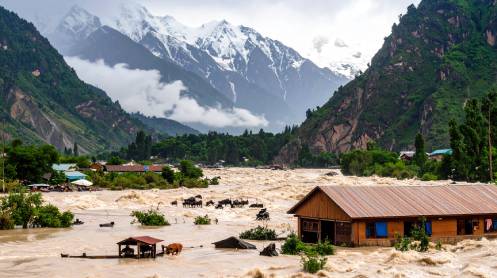
The committee was also briefed on multiple flood-related incidents recorded between July 2 and July 20, including glacial lake outburst floods (GLOFs), flash floods, cloudbursts, and riverbank erosion affecting parts of Gilgit-Baltistan, Khyber Pakhtunkhwa, and Punjab.
The Federal Flood Commission warned that widespread heavy rainfall is forecast across Pakistan through July 25, increasing the risk of further flooding in vulnerable areas.
Senator Jam Saifullah Khan sought a detailed briefing on the government’s preparedness and emergency response plans to address the evolving flood situation.
During the meeting, the committee also expressed dissatisfaction over the Chief Engineer of the Punjab Irrigation Department attending via video link. The chairman directed the irrigation secretaries of Punjab and Sindh to appear in person at the next meeting, warning that failure to do so could result in production orders being issued.
Story by Israr Khan