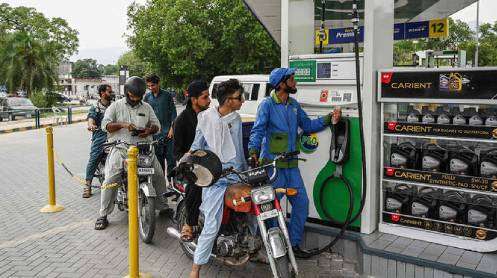
**ISLAMABAD:** The federal government has indicated that it may reintroduce a targeted fuel subsidy programme within the next few days, with financial support from provincial governments, if renewed tensions in the Middle East continue to push international oil prices higher.
Speaking to journalists after a meeting of the Senate Standing Committee on Petroleum on Thursday, Petroleum Minister **Ali Pervaiz Malik** said the government was prepared to revive the targeted subsidy mechanism previously used to shield vulnerable consumers from sharp fuel price increases.
“If the current situation does not improve within the next few days, we will bring back the targeted subsidy mechanism that was earlier introduced to protect the public from the impact of rising fuel prices,” the minister said.
He recalled that Prime Minister **Shehbaz Sharif** had initially allocated **Rs130 billion** for fuel subsidies before expanding the programme with the support of provincial governments.
The minister acknowledged the financial hardships faced by the public but noted that Pakistan’s commitments under the **International Monetary Fund (IMF)** programme and limited fiscal space made it necessary to recover the actual cost of petroleum products from consumers.
He said sustainable relief would only come once geopolitical tensions eased and international oil prices declined, adding that the government remained hopeful for improved regional stability.
Defending the newly introduced **daily petroleum pricing mechanism**, Malik said the system promotes transparency by passing international price changes to consumers gradually rather than through larger weekly or fortnightly adjustments.
“We have made the pricing system transparent and removed political interference. Ogra’s calculations are available publicly, ensuring accountability and helping consumers benefit from greater market competition,” he said.
### Senate Panel Reviews Daily Pricing Mechanism
Earlier, while briefing the Senate Standing Committee on Petroleum, chaired by **Senator Umer Farooq**, the minister said petroleum prices were now being determined independently by the **Oil and Gas Regulatory Authority (Ogra)** under a transparent formula linked to international market trends.
Committee members expressed mixed views on the daily pricing system. **Senator Amir Chishti** welcomed the mechanism, while **Senator Saifullah Abro** criticised it, describing it as “slow poison.”
Ogra Chairman **Nabeel Awan** informed the committee that fuel prices are calculated using a **seven-day rolling average** of international **Platts** benchmarks. He said the approach reduces price volatility by spreading the impact of global market fluctuations over several days, particularly during periods of geopolitical uncertainty.
The committee also voiced concern over the heavy tax burden on petroleum products. Representatives of the Petroleum Dealers Association told lawmakers that frequent price revisions were creating operational challenges for fuel retailers. The committee directed Ogra to consult stakeholders and submit practical recommendations to address these concerns.
### Committee Endorses Pricing Reforms
Separately, a government committee established by the prime minister to review petroleum pricing reforms met under the chairmanship of Petroleum Minister Ali Pervaiz Malik.
According to an official statement, the committee appreciated the **daily pricing mechanism**, describing it as a transparent approach that helps reduce price volatility while improving consumer confidence.
Sub-committees presented recommendations on various aspects of petroleum pricing, while **KPMG** shared a comparative analysis of regional petroleum pricing and taxation frameworks.
The minister also directed **oil marketing companies (OMCs)** to ensure end-to-end digitalisation of the petroleum supply chain to improve transparency, traceability, operational efficiency, and accountability, in line with the prime minister’s earlier directives.
The committee further reviewed the moratorium on new OMC licences and its implications for market competition and investment. It also agreed that the **Inland Freight Equalisation Margin (IFEM)** mechanism requires a comprehensive review, particularly in the context of future petroleum sector deregulation.
The issue of imposing a **windfall tax** was also discussed. The Finance Division, in consultation with the **Federal Board of Revenue (FBR)** and the Petroleum Division, has been directed to submit a report at the committee’s next meeting.
The committee resolved to continue consultations and finalise a comprehensive roadmap for petroleum sector reforms aimed at enhancing transparency, competition, efficiency, and consumer protection.
Story by Khaleeq Kiani