Rooftop Solar Gains Appeal as High Power Tariffs Drive Consumers Towards Self-Generation
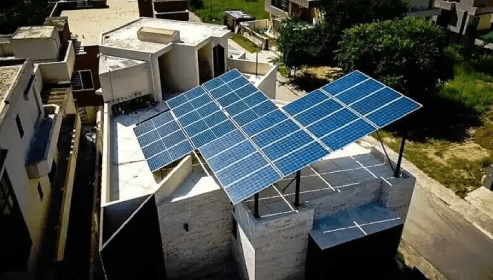
**ISLAMABAD:** Rooftop solar, particularly under net-metering arrangements, is increasingly emerging as a financially attractive option for electricity consumers as high tariffs continue to put pressure on household budgets and businesses.
Despite the government tightening regulations governing solar net metering because of its financial and operational impact on other consumers and the national grid, consumers who can afford the initial investment are increasingly turning to rooftop solar, net metering and off-grid solutions to reduce their dependence on conventional electricity.
Industry estimates suggest that combined generation from net-metering and off-grid solar systems has reached around **20,000 MW**, contributing to a pronounced “duck curve” during daylight hours and creating operational challenges for the power system, particularly during winter when demand patterns change.
Experts estimate that a **10-kilowatt (kW) rooftop solar system** in Pakistan can generate approximately **1,200 to 1,500 units per month**, depending on location, system efficiency and seasonal conditions.
For an upper-middle-income household, such generation can substantially reduce reliance on grid electricity and provide greater protection against rising tariffs and power outages.
An industry analyst noted that Pakistan’s net-metering capacity had expanded nearly 37-fold in six years, reaching around **7,000 MW by June 2026**. The rapid expansion has prompted a major policy shift from traditional net metering towards net billing as authorities seek to address growing technical and financial pressures on the power sector.
Under the net-metering mechanism, consumers use solar electricity for their own consumption and export surplus generation to the grid. The exported electricity is credited by distribution companies (DISCOs) and adjusted against the consumer’s electricity bill, subject to the applicable regulatory framework.
With electricity tariffs for many consumers ranging between **Rs45 and Rs60 per unit**, industry estimates suggest that a 10kW system can generate significant monthly savings through self-consumption. Additional benefits may come from surplus electricity exported to the grid, although export compensation is generally lower than the retail tariff paid by consumers.
For example, a household consuming around **1,200 units per month** and generating approximately **1,400 units** through a 10kW rooftop system could export a portion of its surplus generation to the grid. Depending on consumption patterns, tariffs and applicable export rates, the combined monthly savings and export credits could provide substantial financial benefits.
The cost of installing a 10kW rooftop solar system currently ranges between approximately **Rs1.5 million and Rs2.2 million**, depending on equipment quality, inverter technology, installation standards and other system components.
At prevailing electricity tariffs, industry estimates indicate a potential payback period of around **2.5 to four years**, although actual returns vary according to electricity consumption, system performance, financing costs and regulatory treatment of exported electricity.
Over an estimated system life of **20 to 25 years**, consumers could potentially achieve significant cumulative savings while reducing their exposure to future electricity tariff increases and grid-related disruptions.
However, experts caution that the economics of rooftop solar remain sensitive to regulatory changes. Changes in net-metering or net-billing arrangements, export compensation rates and other rules introduced by the National Electric Power Regulatory Authority (NEPRA) and the Power Division could affect future investment returns.
### Solar Growth Driven by Economics
Analysts say Pakistan’s solar boom has been driven not only by policy but also by major changes in the economics of solar generation.
The rupee has depreciated by around **75 percent**, electricity tariffs have increased by nearly **140 percent**, while solar panel import prices have declined by approximately **60 percent** between FY2021 and FY2025.
These factors have significantly improved the relative economics of rooftop solar, encouraging consumers to invest in self-generation even amid changes to the regulatory framework.
The market is also evolving beyond conventional rooftop systems, with consumers increasingly moving from smaller residential battery units towards larger **14–16 kWh battery energy storage systems (BESS)**.
The trend reflects declining battery costs, growing consumer confidence and increasing demand for self-consumption following changes in regulations governing solar exports to the grid.
### Battery Storage Emerging as Next Growth Area
As battery deployment accelerates, Pakistan has an opportunity to establish a comprehensive regulatory framework covering technical standards, grid integration, safety requirements, market participation and long-term energy-storage planning.
Industry stakeholders believe such a framework could help maximise the value of battery storage for both consumers and the electricity system.
The government is also encouraging the deployment of BESS as a means of reducing pressure on the national grid, particularly during winter months when solar generation and electricity demand patterns can create additional challenges for system operators.
With electricity tariffs expected to remain elevated and consumers increasingly seeking alternatives to grid power, analysts believe rooftop solar combined with battery storage could become an increasingly important component of Pakistan’s future energy mix.