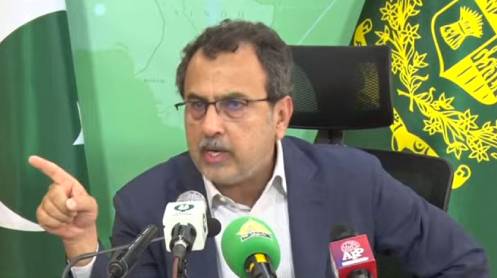
LAHORE: Federal Minister for Energy (Power Division) Awais Leghari on Monday announced that Pakistan’s battery storage revolution had begun, describing it as a major shift that would reduce electricity costs for consumers and ease pressure on the national grid.
Speaking via video link at a media training workshop organised by the LUMS Energy Institute in collaboration with the Power Division, the minister said the growing adoption of electricity storage systems at utility, industrial, and household levels would transform the country’s energy landscape.
Leghari revealed that the government plans to reduce daytime electricity tariffs to around Rs6–7 per unit in the near future, a move expected to accelerate battery adoption across the country.
He explained that lower daytime tariffs would encourage consumers, including solar users, to remain connected to the national grid while using cheaper electricity and solar generation to charge batteries during the day for consumption at night.
“Investing in battery storage at utility, industrial, or household scale is a strong opportunity right now. I encourage investors to take advantage of it,” the minister said.
He added that the combination of solar net metering and battery storage would lower the average electricity cost for consumers by reducing demand during expensive peak evening hours. This, he noted, would also lessen the grid’s dependence on costly thermal power generation.
According to the minister, widespread battery deployment would help the national grid manage evening demand more efficiently by reducing excess power inflows from solar producers during night hours.
Rejecting criticism that recent solar policy reforms were aimed at benefiting Independent Power Producers (IPPs), Leghari stated that the traditional IPP model had effectively ended.
“The IPP model has been buried for good and no new private power producers will be added,” he said, adding that the government had also stopped entering into new power purchase agreements.
He stressed that solar producers had no connection with IPPs and reiterated that government policy no longer favoured thermal power generation.
Responding to a question regarding overbilling and electricity theft, the minister said the government was actively addressing both issues through reforms and technological upgrades.
He announced plans to replace at least 10 million single-phase electricity meters with smart meters, which would help reduce power theft and eliminate unjustified detection bills issued by distribution companies (DISCOs) under anti-theft drives.
Leghari further disclosed that Pakistan currently has around 22,000 megawatts of installed solar power capacity, of which only 8,000MW is connected through net metering, while the remaining 14,000MW operates as off-grid generation.
The minister claimed that the financial losses of DISCOs were gradually declining due to governance reforms, including changes in their boards of directors.
“The losses of Lahore Electric Supply Company alone have decreased from Rs87 billion to Rs22 billion within three years,” he said, adding that several DISCOs would soon be privatised.
During the workshop, Director NGC and ISMO Dr Fiaz Ahmad Chaudhry delivered a presentation on generation capacity additions and power dispatch, while senior officials including Mahfooz Bhatti, Zafaryab Khan, Syed Faizan Ali, Naveed Qaiser, Umer Farooq, and Omer Haroon Malik also addressed participants.
Story by Munawar Hasan