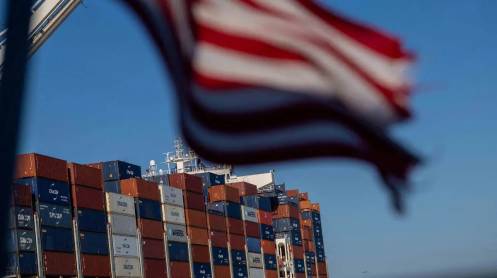
The United States has announced a new round of import tariffs targeting 60 trading partners, including Pakistan, India, China, Japan, the European Union, Canada and the United Kingdom, citing concerns over forced labour practices. The new duties, ranging from 10% to 12.5%, will take effect on Friday, replacing the temporary global tariff introduced earlier this year by President Donald Trump.
Thank you for reading this post, don't forget to subscribe!The move follows the expiration of a 150-day, across-the-board 10% tariff imposed after the US Supreme Court struck down several of the Trump administration’s previous tariff measures in February. To maintain trade restrictions, the administration launched a months-long investigation and has now introduced what officials describe as a more legally durable tariff framework.
US Trade Representative Jamieson Greer said the measures are intended to encourage stronger enforcement of forced labour prohibitions by America’s trading partners.
“The United States has had a forced labour import ban for nearly a century and rigorously enforces it. It’s well past time for our trading partners to do the same,” Greer said.
According to the US Trade Representative (USTR), the affected economies account for the majority of US trade.
Pakistan Among Countries Facing 10% Tariff
Under the final determination, a 10% tariff will apply to imports from Pakistan, along with Argentina, Bangladesh, the United Kingdom, Cambodia, Canada, Ecuador, El Salvador, Guatemala, Honduras, India, Indonesia, Jordan, Malaysia, Mexico, Sri Lanka and Trinidad and Tobago.
Meanwhile, the European Union, Japan, South Korea, Taiwan and Switzerland will face combined tariff rates of 10% to 12.5%, taking into account existing most-favoured-nation (MFN) duties.
The remaining 38 economies, including China, have been assigned a 12.5% tariff.
Pakistan Responded to US Investigation
Before the announcement, Islamabad submitted detailed responses to the USTR, including an additional submission ahead of bilateral trade talks held earlier this month, addressing concerns raised during the forced labour investigation.
Several Products Exempt
The new tariffs will not apply to goods already subject to sector-specific duties, including steel and aluminium products. Exemptions have also been granted for certain energy products, fertilisers, and goods covered under the United States-Mexico-Canada Agreement (USMCA).
Global Backlash
The announcement drew swift criticism from several affected countries.
Japan expressed regret over the decision, with government spokesman Minoru Kihara saying the higher tariff was imposed solely because Japan does not maintain a specific ban on imports produced through forced labour.
Australia’s Trade Minister Don Farrell described the tariffs as “unjustified”, arguing they are inconsistent with the Australia-US Free Trade Agreement and should be withdrawn.
More Tariffs May Follow
Washington is also investigating 16 additional economies over alleged excess industrial capacity, raising the possibility of further tariffs in the coming months.
Trade experts say the latest measures strengthen the Trump administration’s negotiating leverage while making the tariff regime more resilient against legal challenges.
Greta Peisch, former General Counsel at the USTR and now a partner at Wiley Rein, said the extensive investigations make it more likely that the tariffs will withstand court scrutiny and remain in place throughout President Trump’s term.
Similarly, Josh Lipsky of the Atlantic Council said the policy signals a more protectionist US trade strategy while also helping boost federal revenues.
Part of Broader Protectionist Policy
The latest tariff announcement comes days after the United States imposed a 25% tariff on selected Brazilian imports, citing unfair trade practices. Earlier this week, President Trump also ordered 50% tariffs on several Canadian products, including alcohol, automobiles and dairy products, accusing Ottawa of discriminatory trade policies.
Analysts believe the latest actions indicate that the Trump administration intends to continue using tariffs as a key instrument of trade policy, despite recent legal challenges.
While the European Union, which recently concluded a trade agreement with Washington, said it expects the United States to honour the commitments outlined in the EU-US Joint Statement, trade observers caution that global trade relations remain increasingly uncertain amid the expanding use of tariffs by the world’s largest economy.
Story by AFP / Reuters