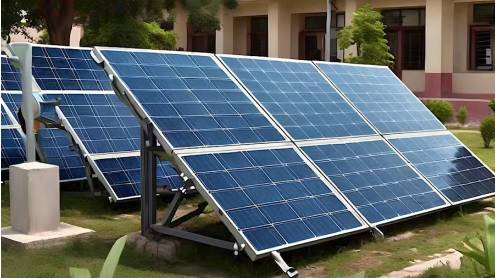
The rooftop solar boom is already generating demand for electricians, installers, inverter technicians, battery vendors and after-sales workers well beyond what official data captures.
The quality of newly created employment opportunities in the renewable sector is a policy concern. Around three-quarters of the projected jobs are semi-skilled or unskilled. One in five renewable-energy workers is part-time. Small rooftop firms retain only sales staff while assembling temporary or “floating” technical teams on a project-by-project basis. More than 80 percent of renewable energy companies provide in-house training to address gaps in the public TVET system. The training capacity is concentrated in the Punjab, leaving other regions less equipped to supply the necessary workforce. The Pakistan Bureau of Statistics does not yet classify green jobs, so this entire workforce remains statistically invisible to policy and social protection systems.
First, legislate a statutory National Just Transition Commission. Germany managed its coal phase-out through a Coal Commission, in which relevant stakeholders such as the government, employers, unions, scientists and affected regions negotiated both the phase-out timetable and the compensation package for the region and workers. Spain wrote just transition into its 2021 climate law and mandated five-year territorial agreements between the state, regions, unions and municipalities, administered by a dedicated Just Transition Institute with its own budget and staff.
Building on the Parliamentary Forum on Energy and Economy and the Federal and Provincial Tripartite Consultative Committees (established under ILO Convention 144), Pakistan should create a statutory National Just Transition Commission to review transition decisions. The parliament and provincial legislatures should legislate just-transition guarantees rather than leave them to administrative discretion. Punjab Labour Code 2026 expands the scope of tripartite consultation to include issues of employment and unemployment in the province and provides a statutory basis for the consultative committee.
Second, make a labour impact assessment a legal pre-condition for every major energy sector decision. No plant retirement, DISCO privatisation, IPP renegotiation or procurement round above a defined threshold should proceed without a published assessment of direct, indirect and induced employment effects, disaggregated by gender, contract status and district, together with a mitigation plan approved before the decision is finalised. Vietnam has developed a workable labour force projection methodology as part of its energy transition programme. Pakistan can do the same.
Third, establish and finance a National Just Transition Fund. Financed through employer levies on fossil-fuel-intensive employers, a modest transition charge on electricity use and grant-based international climate finance, the Fund should cover income support, retraining, relocation assistance, early retirement aligned with the National Electricity Policy’s employee-protection clause and economic diversification in coal- and thermal-dependent districts. Tripartite governance, with workers, employers and provinces represented, is necessary to ensure resources reach displaced workers.
Fourth, attach labour conditionalities to public and international support. If Pakistan could guarantee returns for independent power producers for three decades, it can also make decent work a condition for the support now being given to the renewable energy sector. Tariff guarantees and public procurement should be conditional on written contracts, social security and EOBI registration, safety standards, freedom of association and apprenticeship and gender-based hiring targets. The same logic applies to international finance. Public money should not be used to promote labour market informality.
Fifth, count the workers. PBS should introduce a green-jobs classification into the Labour Force Survey. The NEPRA, the Power Division and Energy Departments should be required to publish plain-language transition briefs, sex-disaggregated labour data in the energy sector and plant-level restructuring notices. Workers cannot bargain over decisions that are kept hidden and policymakers cannot plan for a workforce they do not measure.
Finally, the unions must organise the new workforce. The rooftop solar installer on a temporary team, the EV mechanic in a workshop and the battery vendor in a local market operate outside traditional organising channels. Trade unions need to map where green work actually happens; organise sectorally rather than workplace-by-workplace; recruit through services such as legal aid, accident-claim support and certification assistance; and build participation models that women can use safely. The Punjab Labour Code 2026, extending the right to organise to informal and self-employed workers, has opened a legal avenue that the labour movement has yet to use.
Article 9A of the constitution recognises every citizen’s right to a clean and healthy environment; read together with the rights to association, equality and dignified working conditions, it establishes that environmental and labour objectives carry equal constitutional weight. Pakistan can make the energy transition a virtuous cycle: cheaper and cleaner energy; better jobs; stronger social protection; women’s inclusion; safer workplaces; and a more resilient economy. Or it can create a “green” version of the old exploitative and informal economy.
The most ambitious policy scenario