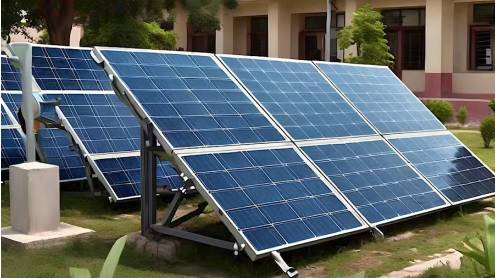
To date, rooftop capacity installed under a net metering policy (excluding off-grid) has surpassed 7 GW
Iftikhar Ahmad
In early 2025, Pakistan became one of the fewer than 20 nations that generated at least 25 percent of their electric energy from solar. In 2020, solar energy had accounted for less than 3 percent of total utility electricity generation. Pakistan imported over 30 GW of solar modules in 2024 and 2025. Its more than 33 GW of distributed solar capacity is equivalent to two-thirds of Pakistan’s total installed generation capacity of 49 GW.
To date, rooftop capacity installed under a net metering policy (excluding off-grid) has surpassed 7 GW. The off-grid capacity is estimated at twice that amount. The energy transition in Pakistan is no longer a promise in a policy document like NDC 3.0 or a hypothetical question; it is a structural shift already under way, driven largely by consumers rather than the governments.
The relevant policy question is, therefore, no longer whether Pakistan will transition, but how the costs and benefits of that transition will be distributed: who pays, who gains and who is protected during the adjustment. The current institutional evidence shows that the distribution is skewed. Adjustment costs are borne by consumers and workers and the frameworks that could protect them are absent from energy planning.
Consider the labour market into which this transformation is landing. The Labour Force Survey 2024-25 records a workforce of 85.6 million, of whom 80.8 percent, roughly 69 million people, work informally – without written contracts, minimum wages, access to social protection or legal recourse when employment ends. Female labour force participation stands at 24.4 percent, among the lowest in South Asia. Of the country’s 33.6 million wage and salaried employees, only 5.8 percent (fewer than two million workers) belong to a trade union or association. This is the institutional base from which workers are expected to negotiate the largest economic restructuring in a generation.
The Indicative Generation Capacity Expansion Plan 2025-35 determines which power plants are to be developed and which are to be closed or retired over the next decade. Its consultation list names the Power Division, the regulator (NEPRA), market operators (DISCOS), the Special Investment Facilitation Council and a university institute. It includes no trade union and no workers’ body; not even the Ministry of Overseas Pakistanis and Human Resource Development, nominally responsible for labour issues. The plan schedules 2,577 MW of thermal retirements but contains no employment impact assessment or worker transition framework.
The legal framework exacerbates the governance gap. In January 2025, the federal government invoked the Essential Services (Maintenance) Act, 1952, to ban trade union activity across the electricity sector by declaring it an essential service. The ILO’s supervisory bodies have long held this law incompatible with Conventions 87 and 98, which Pakistan ratified in the 1950s. The National Industrial Relations Commission suspended the order in March 2025, holding that it potentially violated fundamental constitutional rights. Still, the statute remains in force and can be applied in future. The de jure right to organise exists, but the de facto right to organize can be suspended at administrative discretion precisely when contested reforms, such as DISCO privatisation are pursued.
By global standards, Pakistan is not a major coal employer, but coal matters deeply in the few places where coal jobs and supply chains are concentrated. Five Thar coal IPPs supply 3,300 MW and Shanghai Electric alone reports directly employing around 7,000 Pakistani workers in its Thar operations. Other than Thar’s mechanised open-pit mines, coal mining in Balochistan, Punjab’s Salt Range and Sindh remains labour-intensive, employing workers with few alternative livelihoods in coal towns like Duki. Even the modest thermal retirements already scheduled will have significant localised effects on power sector workers, contractors and the surrounding service economy. Pakistan currently has no dedicated transition instrument to manage these effects: no wage insurance, no structured redeployment mechanism and no regional diversification compact.
The same issue exists on a larger scale in the distribution companies. In the 2026 FES report on Just Energy Transition, trade union interviewees report that roughly 80 percent of the workforce across energy sector workplaces is now engaged through third-party contractors. These workers service the grid but have no formal employment relationship with the entities being restructured and will not appear on any severance list when a DISCO is privatised. A transition that converts formal, unionised, pensionable employment into informal, contracted, unprotected work does not meet the ILO’s definition of a just transition.