KARACHI: Illegal cutting of mangroves and land reclamation at Karachi’s Korangi Creek has raised serious environmental concerns, with encroachers allegedly clearing mangrove areas to reclaim land near the Mangrove Biodiversity Park.
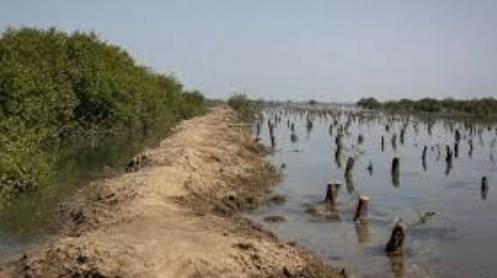
While mangroves are routinely cut illegally for firewood, the latest activity involves uprooting mangroves and constructing earthen bunds to restrict tidal water from reaching the trees, according to observations at the site.
The Sindh Forest Department (SFD) has confirmed that the activity is taking place on land under its jurisdiction. However, officials said efforts to intervene had been complicated by a legal dispute, with police declining to take action on the grounds that the land had allegedly been allotted by the Board of Revenue and that the matter was sub judice.
A visit to Korangi Creek found mangrove cutting and land reclamation taking place alongside the Mangrove Biodiversity Park, inaugurated by Karachi Mayor Murtaza Wahab in September last year.
A large portion of land beside the park’s boundary walls has been enclosed with an earthen bund designed to restrict the flow of water towards the mangroves. Mangrove stems were visible in standing water inside the enclosed area, indicating that the trees had been cut.
In some sections, construction of a wall was also under way, while debris had been dumped across parts of the open land. The activity has gradually transformed the area into what appears to be an enclosed plot.
A security guard has also reportedly been deployed by private parties to monitor the land.
Following inquiries, the SFD sent a team to inspect the site. A senior department official said the Forest Department was aware of the issue and maintained that the land belonged to it.
The official alleged that similar “illegal allotments” had been made by the Board of Revenue and said the Forest Department had taken action against such encroachments several times.
According to the official, the department had also attempted to remove the bunds in the current case. However, the opposing party approached the courts, after which police refused to take further action.
“Unless the legal issue is resolved, we can’t act on our own,” the official said.
He added that the practice had continued for several months. Constructing bunds to prevent tidal water from reaching mangroves was a longstanding technique, he said, explaining that once the mangroves dried out, the trees could be cut either for firewood or as part of land encroachment efforts.
The official said the department was continuing efforts within its legal mandate to protect the remaining mangrove cover.
Mangroves provide vital coastal protection
Conservationists and climate change experts have expressed alarm over the continued destruction of Karachi’s mangroves, warning that the loss of natural coastal barriers could increase the city’s vulnerability to extreme weather and other hazards.
Conservationist and climate change expert Rafiul Haq said mangrove cutting had been taking place in the area for some time and that substantial portions of land had already been encroached upon over the years.
He warned that continued degradation of mangrove forests would make coastal communities more vulnerable to natural hazards, including tsunamis and hurricanes, as mangroves provide an important natural buffer against coastal threats.
Haq called for an immediate halt to mangrove cutting and said Pakistan already had adequate laws dealing with climate change and environmental protection. The major challenge, he said, was effective implementation.
He alleged that influential individuals were often able to avoid consequences for environmental violations.
Climate change expert Masood Lohar said mangrove destruction was not limited to Korangi Creek but was also occurring at other locations in Karachi and across the Indus Delta.
Describing the situation as “very concerning”, Lohar warned that a major tsunami or other coastal disaster could cause severe flooding in areas such as Korangi and DHA if the natural protection provided by mangroves continued to disappear.
Environmentalist Tariq Alexander Qaiser also stressed the need for greater vigilance to protect Karachi’s remaining mangroves and tree cover.
He said existing mangroves must be protected because they were critical to the health and resilience of the city and played an important role in tackling climate change.
With Karachi already facing increasing environmental and climate-related pressures, experts stressed that further loss of mangrove cover could have serious long-term consequences for the city’s coastal ecosystem and flood resilience.
Story by Huzaifa Jawaid & Waqas Ali Ranjha