
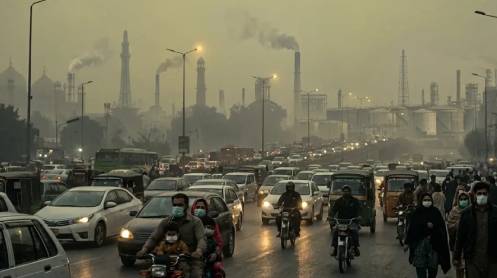
LAHORE: Rising air pollution in Lahore is threatening not only public health but also the city’s trees and vegetation, as dust, fine particulate matter and toxic gases damage leaves, disrupt essential biological processes and weaken plant growth.
Environmental experts warn that prolonged exposure to polluted air can cause leaves to turn yellow, dry out and fall prematurely. During winter, increased smog, dust and airborne pollutants accumulate on leaf surfaces, reducing their ability to absorb sunlight and carry out photosynthesis.
According to Bagh-e-Jinnah Project Director Jaleel Ahmed, dust and toxic chemical particles can block the pores on leaves, disrupting gas exchange and photosynthesis. This reduces food production in plants and adversely affects their growth and development.
He explained that harmful gases, including sulphur dioxide, nitrogen oxides and ground-level ozone, can also damage plant cells and weaken vegetation.
Ahmed stressed the need for regular maintenance and protective measures to minimise the impact of air pollution on urban greenery.
The Parks and Horticulture Authority (PHA) regularly sprays water in different parts of the city to remove dust and pollutants accumulated on leaves. He said rainfall naturally cleans plant surfaces, but artificial water spraying becomes essential during extended dry periods.
He also advised residents to regularly wash the leaves of plants in their home and rooftop gardens to remove accumulated dust and help maintain their health.
Several research studies have also documented the damaging effects of air pollution on Lahore’s vegetation.
A study conducted last year by researchers from the Botany Department of Government College University Lahore examined plants growing along seven major roads in the city. It found that pollutant accumulation on leaves affected photosynthesis, leaf pores and other essential biological functions.
The researchers also identified differences among plant species in their ability to withstand air pollution, indicating that some varieties are more tolerant of polluted environments than others.
Similarly, a 2024 study by researchers at the University of Agriculture Faisalabad analysed tree leaves collected from four locations across Lahore. The findings revealed higher concentrations of heavy metals, including lead, cadmium and zinc, in trees growing near commercial areas and heavily trafficked roads.
The findings highlight the growing environmental cost of urban air pollution and the need for stronger pollution-control measures and regular care to protect Lahore’s trees and green spaces.
Story by Asif Mehmood