

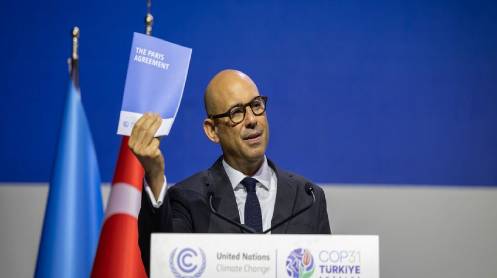
ANTALYA, November 14: The 31st United Nations Climate Change Conference (COP31) has intensified global efforts to bridge the gap between climate commitments and practical implementation, bringing governments, financial institutions and businesses together to mobilise investment for climate action.
Thank you for reading this post, don't forget to subscribe!During Finance and Trade Day, held alongside the second day of the COP31 Business Forum, participants focused on improving access to climate finance, developing investment-ready projects and addressing barriers preventing developing countries from implementing their climate priorities.
Four More Countries Join Climate Implementation Initiative
Chile, Lebanon, Mexico and Zambia have joined the COP31 Presidency’s Climate Implementation Bridge (BRIDGE) platform, bringing the total number of participating countries to nine. The initiative was initially launched with Ethiopia, Fiji, Indonesia, Pakistan and Uzbekistan.
The BRIDGE platform aims to help countries transform their national climate commitments into bankable investment projects by identifying implementation barriers, strengthening institutional capacity and connecting governments with technical and financial partners.
In support of the initiative, Türkiye’s Ministry of Treasury and Finance, Ministry of Environment, Urbanization and Climate Change, and the United Nations Development Programme (UNDP) signed a Memorandum of Understanding. Türkiye also committed $3 million in grants to support the platform’s operationalisation.
COP31 President Murat Kurum said the initiative would help close the gap between climate ambition and implementation by connecting national priorities with the finance, expertise and partnerships required to deliver tangible results.
Global Financial Institutions Strengthen Climate Investment
The conference also witnessed growing cooperation among multilateral development banks (MDBs) to increase investment in climate adaptation and resilience.
The Asian Development Bank (ADB) and the European Bank for Reconstruction and Development (EBRD), among other institutions, pledged to expand investment and mobilise additional public and private finance to address growing demand for climate resilience projects.
Meanwhile, Australia’s Clean Energy Finance Corporation (CEFC), in collaboration with the Natural Resources Defense Council and SOAS University of London, launched the Green Bank Accelerator to help developing countries strengthen their green banking capabilities and improve access to climate finance.
The CEFC has mobilised more than AUD 100 billion towards Australia’s net-zero transition over just over a decade.
COP31 President of Negotiations and Australian Minister for Climate Change and Energy Chris Bowen highlighted the challenges faced by vulnerable countries, particularly small island developing states, noting that only 0.2 per cent of global climate finance for adaptation reaches these nations.
UN Climate Change Executive Secretary Simon Stiell stressed the need for a simpler and fairer climate finance system, warning that developing countries continue to face high borrowing costs, mounting debt and increasingly severe climate disasters.
Business Forum Highlights Role of Finance and Technology
The two-day COP31 Business Forum, organised by the Union of Chambers and Commodity Exchanges of Türkiye (TOBB), brought together approximately 4,000 participants and 100 speakers across 23 sessions, making it the largest business gathering at a COP conference.
Government representatives, business leaders, investors and financial institutions discussed how emerging technologies, artificial intelligence, investment and private-sector participation could accelerate the deployment of climate solutions.
TOBB also released a synthesis of recommendations focusing on climate finance, standards and market regulations, demand creation, institutional cooperation and implementation tools.
TOBB President Rifat Hisarcıklıoğlu emphasised the importance of financing climate investments, strengthening global energy security, accelerating electrification in transportation and industry, promoting sustainable agriculture and improving urban resilience.
Urban Resilience and Climate Finance in Focus
COP31 also advanced the Sustainable Urban Resilience Financing Facility (SURFF), a priority initiative designed to help cities and countries convert urban resilience plans into investment-ready projects.
Supported by international financial institutions, city networks, UN entities and multilateral development banks, including the World Bank, Asian Infrastructure Investment Bank, ADB and EBRD, SURFF will connect cities with existing financial resources, technical expertise and implementation support rather than establish an entirely new funding mechanism.
The initiative aims to strengthen urban infrastructure and improve cities’ capacity to withstand the growing impacts of climate change.
Separately, the conference strengthened cooperation with the Network for Greening the Financial System (NGFS) on assessing climate-related economic and financial risks and supporting the transition towards low-carbon economies.
Focus on Turning Commitments into Results
UNDP Administrator Alexander De Croo said BRIDGE would connect countries’ climate plans with available public and private investment, combining national leadership, financial expertise and implementation support.
ADB President Masato Kanda and EBRD President Odile Renaud-Basso also reaffirmed their institutions’ commitment to accelerating climate investment, strengthening resilience and supporting low-carbon economic growth.
The discussions at COP31 highlighted that mobilising finance, improving institutional coordination and engaging the private sector are essential to translating international climate commitments into tangible outcomes, particularly for developing countries facing the greatest climate vulnerabilities.