# Karachi’s Sewage Treatment Projects Remain Stalled as Untreated Waste Flows into Sea
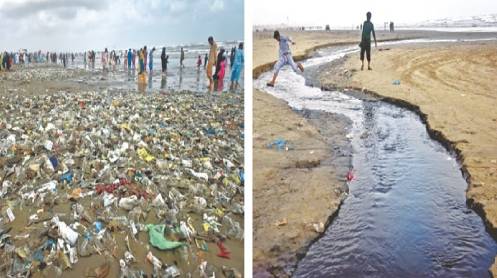
Thank you for reading this post, don't forget to subscribe!**KARACHI:** Karachi’s sewage treatment crisis has persisted for nearly two decades, with funding disputes, bureaucratic hurdles and repeated changes in project plans leaving the vast majority of domestic sewage and industrial effluent untreated before it reaches the sea.
According to a study by the **Karachi Water and Sewerage Corporation (KWSC)**, the city generates around **460 million gallons of sewage per day**, of which only approximately **35 million gallons per day (MGD)** is currently treated. The remaining **425 MGD** is discharged untreated into waterways and the Arabian Sea.
The **S-III project**, originally designed to treat Karachi’s domestic sewage, has faced prolonged delays. An engineer associated with the project said its design was initiated in 2007, final approval was granted in 2013 and construction began in 2014.
The project was initially estimated to cost around **Rs8 billion**, with the federal and Sindh governments agreeing to share the cost equally. The estimated cost subsequently increased to around **Rs36 billion**, triggering disputes over financing.
The Executive Committee of the National Economic Council (ECNEC) approved a revised PC-I in 2023, under which the federal government agreed to provide its original financial share while the Sindh government would bear the additional cost. According to a project official, the federal government has already released its committed share but has since stopped further funding.
Construction was also largely stalled between 2019 and 2023 due to funding constraints and the Covid-19 pandemic.
Around **33 kilometres of trunk sewer pipeline from Surjani to Mauripur** has now been substantially completed, while work is continuing at Treatment Plant-I (TP-I) in Haroonabad and Treatment Plant-III (TP-III) in Mauripur. TP-I is designed to treat **100 MGD**, while TP-III has a planned capacity of **180 MGD**.
TP-III was partially restored following directions from the Supreme Court and inaugurated by then-Chief Justice **Saqib Nisar** on July 22, 2018. Although it initially treated around 54 MGD, the accumulation of silt in the old pipeline has reduced its current treatment capacity to approximately **35 MGD**.
The project engineer said the remaining S-III works are expected to require around **Rs29 billion**. Phase-II, which included the Malir River trunk sewer and Treatment Plant-IV, was removed from the project and shifted towards a public-private partnership model.
The completion deadline has now been extended from **June 2026 to December 2027**, while the Sindh government has allocated only **Rs1 billion** for the project during the current financial year.
### Industrial Waste Adds to Karachi’s Sewage Crisis
The city’s environmental problems are further aggravated by the discharge of untreated industrial effluent.
A senior Sindh government official said the **Combined Effluent Treatment Plant (CETP)** project has remained delayed for around 20 years. The federal government prepared its first feasibility study in 2006, followed by a KWSC PC-I in 2009 with an estimated cost of **Rs7.36 billion**.
Following Supreme Court directions in 2016, the federal government approved a new scheme in 2017 involving **five treatment plants** at a cost of Rs11.789 billion. Under the plan, Sindh was to contribute 67 per cent of the cost and the federal government 33 per cent. The plants were designed to collectively treat around **94 MGD** of industrial wastewater.
The project was later shifted to a public-private partnership, with responsibility transferred from KWSC to the provincial Industries Department in 2020.
An Industries Department official said the Sindh government, under Chief Minister **Murad Ali Shah**, has decided to revive the project through the PPP model. The first priority is a **20 MGD treatment plant at Haroonabad** to serve the SITE Industrial Area.
Officials estimate that around **35 MGD of wastewater** from the area enters stormwater drains, comprising approximately 20 MGD of industrial effluent and 15 MGD of domestic sewage, before flowing through the Lyari River into the sea.
However, the project faces another hurdle as KWSC has declined to provide **16 acres at Haroonabad**, saying the land is required for expansion of TP-I and a workshop. Officials warned that the CETP project could be abandoned unless an alternative site is identified.
### Marine Ecosystem Faces Long-Term Damage
WWF Technical Adviser **Moazzam Khan** questioned the KWSC estimate of 460 MGD of daily sewage generation, arguing that the figure was calculated against Karachi’s approximately 650 MGD water supply from the Indus River and Hub Dam.
He said Karachi’s growing population and increased reliance on groundwater could mean that actual sewage generation is considerably higher.
Khan warned that marine biodiversity around the mouths of the **Lyari and Malir rivers** has already largely disappeared. He identified **Sea View, Korangi Creek, Gizri Creek, Karachi Port, Port Qasim, Ibrahim Hyderi and Rehri Goth** among the areas worst affected by untreated wastewater.
He cautioned that continued delays in treating industrial effluent could cause **irreversible damage to marine ecosystems within Pakistan’s maritime boundaries**, highlighting the urgent need for Karachi’s long-delayed sewage and industrial wastewater treatment projects to be completed.
Story by Syed Ashraf Ali