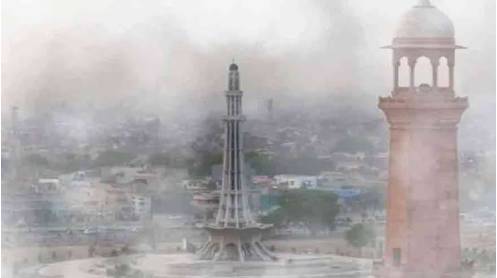
LAHORE: The Punjab government has urged political parties to avoid politicising the worsening smog crisis, describing air pollution as a scientific, environmental and public health challenge, as Lahore, Multan and other cities continue to experience hazardous air quality.
Thank you for reading this post, don't forget to subscribe!Senior Punjab Minister Marriyum Aurangzeb said on Wednesday that environmental protection and public health should remain above political differences, stressing that smog threatens the lives and well-being of millions of people.
“Smog is not a political issue. It is a scientific, environmental and public health challenge,” she said during a press conference.
On Wednesday night, Lahore topped the global ranking of major polluted cities, recording an Air Quality Index (AQI) of 358, while India’s capital, New Delhi, ranked second with an AQI of 248.
The Punjab Environment Protection Agency (EPA), meanwhile, reported that pollution-laden air travelling from India had contributed to increased concentrations of fine particulate matter (PM2.5) across the province during the Diwali period.
According to the EPA’s assessment, approximately 50% of Punjab was affected by air originating from India during the preceding 24 hours.
Forward-trajectory modelling indicated that pollution released across the border on Diwali night could reach Lahore from Amritsar in approximately two hours, Faisalabad in 12 hours and Multan in around 11 hours, highlighting the potential impact of transboundary air pollution.
Monitoring data also revealed significant geographical differences in pollution levels across Lahore. The Wagah Border monitoring station recorded a 275% increase in PM2.5 concentrations, with levels peaking between 3am and 4am. In comparison, Safari Park on the western side of the city recorded an increase of only 15%.
The EPA said the east-to-west variation was consistent with the movement of pollution carried by easterly winds from across the border.
The agency’s analysis further showed that Lahore’s overall AQI increased from 366 on November 8 to 440 on November 9, reaching its highest recorded level at 9am.
However, the findings do not establish cross-border pollution as the sole cause of the smog, as local emissions and prevailing weather conditions also contribute to deteriorating air quality.
Punjab Government Highlights Monitoring and Enforcement Measures
Marriyum Aurangzeb said Punjab had introduced an integrated, evidence-based and technology-driven system for smog mitigation, monitoring and enforcement under Chief Minister Maryam Nawaz.
She maintained that before 2024, the province lacked an integrated mechanism for managing air pollution, while the government had now established round-the-clock monitoring, scientific forecasting, technology-enabled surveillance and rapid response systems.
She said coordinated enforcement measures were being implemented across industrial units, transport, agriculture, brick kilns and other major sources of pollution.
Comparing air quality figures, the minister claimed that Lahore’s AQI, which had exceeded 2,000 and reached approximately 2,400 on November 11, 2024, remained below 450 on November 11, 2026.
She attributed the improvement to scientific planning, sustained mitigation efforts, modern monitoring infrastructure and stricter enforcement.
The provincial government has also introduced an advanced air quality forecasting system capable of predicting pollution trends five to seven days in advance, allowing authorities to take preventive measures before conditions worsen.
According to the minister, air pollution indicators in different areas of Punjab have improved by 23% to 64%.
New Delhi Faces Severe Pollution Monitoring Crisis
Meanwhile, New Delhi has experienced extremely hazardous pollution levels, with particulate matter concentrations overwhelming the capacity of several air quality monitoring instruments during the Diwali period.
The monitoring equipment, installed when India’s National Air Quality Index was introduced in 2015, was calibrated to measure pollutant concentrations of up to 1,000 micrograms per cubic metre.
The World Health Organisation (WHO) recommends a daily maximum of just 15 micrograms per cubic metre for PM2.5, fine particles capable of penetrating deep into the lungs and associated with serious health risks, including cancer.
Opposition politicians in India accused the BJP-led government of deliberately deactivating air quality monitoring stations during Diwali to conceal the severity of pollution.
Aam Aadmi Party Delhi President Saurabh Bharadwaj questioned the credibility of the monitoring system, while senior Congress leader Ajay Maken demanded accountability over missing pollution data.
However, India’s Central Pollution Control Board (CPCB) rejected allegations of deliberate under-reporting, explaining that its automated data validation system excludes hourly readings exceeding the calibrated measurement range from official calculations.
Following the resumption of monitoring, PM2.5 concentrations in New Delhi’s Mandir Marg locality reached 879 micrograms per cubic metre, according to IQAir data cited from a government monitoring station. This was more than 58 times the WHO’s recommended daily limit.
Smog Disrupts Transport and Raises Public Health Concerns
The worsening smog has also disrupted road transportation in Pakistan, forcing authorities to close sections of motorways due to dangerously low visibility.
Earlier this week, the motorway section between Shamkot and Abdul Hakeem was closed to all traffic, while heavy vehicles were also restricted on the Sher Shah-Multan section towards Khanewal.
The continuing deterioration in air quality across Pakistan and India highlights the need for stronger regional cooperation, effective pollution monitoring and sustained action against industrial, transport and agricultural emissions.
While cross-border pollution has emerged as a significant factor during the recent smog episode, addressing local emission sources and improving environmental enforcement remain essential to achieving lasting improvements in air quality.
Story by Imran Gabor with Inputs from AFP