
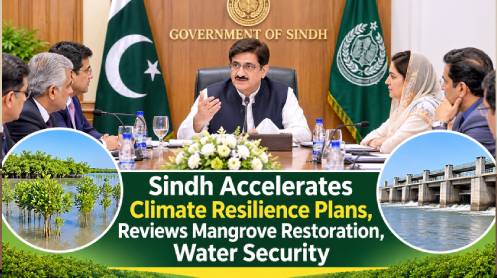
KARACHI: Sindh Chief Minister Syed Murad Ali Shah has directed provincial departments to accelerate climate change mitigation and adaptation initiatives, emphasising the need to develop resilient infrastructure, strengthen water security, restore mangrove forests and expand renewable energy projects to protect communities against growing climate risks.
Thank you for reading this post, don't forget to subscribe!Chairing a high-level meeting at the Chief Minister’s House on Thursday, the chief minister reviewed ongoing climate-related projects and future priorities, stressing that climate change was not merely an environmental concern but a fundamental development challenge for Sindh.
“Climate change is not just an environmental issue for Sindh; it is a fundamental development challenge,” Murad Ali Shah said, adding that the province remained vulnerable to floods, droughts, water scarcity and coastal erosion.
He said protecting people’s lives, livelihoods and water resources remained the government’s foremost priority, directing all departments to work together to promote climate-resilient and sustainable development.
The meeting was attended by Chief Secretary Asif Hyder Shah, Principal Secretary Agha Wasif, Planning and Development Board Chairman Najam Shah, Environment Secretary Faisal Aqili, Energy Secretary Shahab Ansari, Sindh People’s Housing for Flood Affectees CEO Khalid Shaikh, Chief Conservator Riaz Wagan, SWEEP Project Director Usman Moazzam and Special Secretary Energy Aslam Soomro.
Water Security and Irrigation Infrastructure
The chief minister reviewed progress on water conservation and irrigation rehabilitation projects, with officials briefing the meeting that the restoration of 552 miles of canals across 23 districts of Sindh had been completed.
The rehabilitation had resulted in water savings of 884 cusecs, according to the briefing.
The meeting was also informed that 207 small dams had been constructed across the province, providing a combined water storage capacity of approximately 650,000 acre-feet.
Murad Ali Shah directed the relevant departments to improve irrigation efficiency, accelerate drainage projects and ensure the effective utilisation of available water resources. He also emphasised rainwater harvesting, improved irrigation practices and measures to address water shortages.
He instructed officials to complete drainage schemes on priority and strengthen infrastructure to reduce the impact of floods and other climate-related disasters.
Mangrove Restoration and Coastal Protection
The meeting reviewed the Delta Blue Carbon project, which aims to restore mangrove forests across 126,000 hectares.
The chief minister stressed the importance of protecting the Indus Delta, expanding mangrove coverage and strengthening natural coastal protection systems to address coastal erosion and safeguard vulnerable communities.
He also reviewed the Sindh Coastal Resilience Project, under which more than 500,000 people in Thatta, Sujawal and Badin are expected to benefit from improved protection against coastal climate risks.
He said safeguarding coastal communities and protecting their livelihoods remained among the government’s key priorities.
Renewable Energy and Solarisation Initiatives
The chief minister also reviewed plans to generate an additional 2,360 megawatts of electricity through wind energy projects.
The meeting discussed proposed solar energy initiatives for 275,000 low-income and off-grid households to improve access to affordable and reliable electricity.
Murad Ali Shah directed the Energy Department to promote renewable energy development and encourage private-sector investment in clean energy projects.
Officials also briefed the meeting on plans to promote solar-powered irrigation systems and climate-resilient agricultural practices. The potential for generating clean energy from waste was also discussed.
$540 Million Programme for Flood-Affected Communities
The meeting received a briefing on the $540 million STAR WASH Programme, which aims to provide clean drinking water and sanitation facilities in flood-affected villages across Sindh.
The first phase of the programme targets the provision of essential services to approximately 1.2 million to 1.5 million people.
The chief minister directed relevant authorities to strengthen collaboration with international development partners and private investors to accelerate implementation and expand the programme’s impact.
He emphasised that local communities must remain at the centre of the province’s climate change strategy, adding that development initiatives should deliver lasting and meaningful improvements in people’s lives.
Concluding the meeting, Murad Ali Shah instructed all concerned departments to accelerate priority projects and adopt coordinated measures to address water scarcity, flooding, coastal erosion and other climate-related threats.
He reaffirmed that climate resilience would remain a major priority of Sindh’s development agenda, with particular focus on protecting vulnerable communities, strengthening infrastructure and ensuring sustainable management of natural resources.