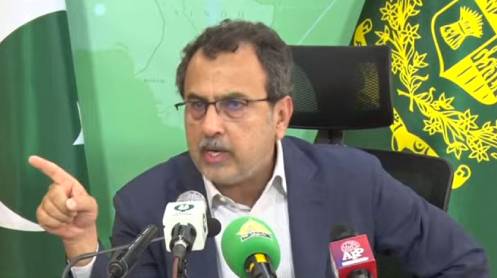
ISLAMABAD: An inter-ministerial committee led by Minister for Power Sardar Awais Ahmad Khan Leghari has proposed a major restructuring of Pakistan’s automobile industry, with the new framework focusing on exports, greater localisation, new energy vehicles (NEVs), lower tariffs, increased competition and integration of local auto parts into global value chains.
Thank you for reading this post, don't forget to subscribe!The committee, constituted to review and propose amendments to the draft Automotive and Auto Parts Manufacturing Policy 2026–31, has agreed on seven broad principles aimed at transforming the sector over the next five years.
The proposed policy seeks to gradually shift the industry away from heavy reliance on tariff protection towards performance-based incentives, mandatory export targets, technological upgrading, competition and measurable domestic value addition.
Mandatory Export Targets for Automakers
One of the key proposals is the introduction of a legally enforceable export regime for original equipment manufacturers (OEMs), with penalties for companies that fail to meet their targets.
Under the proposed framework, manufacturers of cars, jeeps and SUVs would be required to raise exports from zero in 2026–27 to 12% of factory-gate production value by 2029–30 and 2030–31.
Projected exports by the sector would rise from $160.89 million in 2027–28 to $596.1 million in 2030–31, with cumulative OEM exports estimated at $2.391 billion during the five-year policy period.
Tractor manufacturers would see their export requirement increase from 5% in 2026–27 to 15% by 2030–31, while bikes and rickshaw manufacturers would move from zero to 15%.
Auto parts manufacturers would also be expected to significantly increase exports, from an estimated $240 million in 2026–27 to $700 million in 2030–31.
Combined exports by OEMs and parts manufacturers are projected to reach $4.586 billion over 2026–31.
Export targets could become a condition of manufacturing licences. Companies failing to meet their obligations could face additional customs duty on imported completely knocked-down (CKD) kits equivalent to the value of the export shortfall. Continued non-compliance could ultimately lead to cancellation of the manufacturing licence.
Export Incentives and Localisation
The committee has proposed a fiscally neutral Drawback of Local Taxes and Levies (DLTL) scheme to support exporters.
Eligible OEMs and parts manufacturers would receive 10% of net FOB export value as baseline support, with an additional 5% available where export value increases by at least 5% year-on-year.
The scheme would be financed through Federal Excise Duty (FED) collected from internal-combustion-engine vehicles. Total FED collection during the policy period is estimated at around Rs349 billion, compared with approximately Rs191 billion in DLTL disbursements.
The proposed policy would also introduce a Minimum Domestic Value Addition (MDVA) regime to measure localisation.
For conventional cars, domestic value addition would gradually rise to 40% by 2030–31, while the requirement for conventional LCVs, trucks and buses would reach 45% and 40%, respectively.
The MDVA target for conventional tractors would rise to 80%, while bikes and rickshaws would reach 90%.
For NEVs, the requirement would start at 10% and increase to 15% by 2030–31.
Manufacturers would be required to submit detailed information covering bills of materials, country of origin, suppliers, acquisition costs, payroll and factory expenditure. Domestic value-addition statements would be submitted twice a year and could be subject to risk-based third-party audits.
Tariff Rationalisation
The committee has also proposed a substantial reduction in automobile tariffs, targeting reductions of up to 80%, alongside the eventual elimination of regulatory duty (RD) and additional customs duty (ACD).
The automobile tariff structure would be aligned with the National Tariff Policy, with a one-year implementation lag for the sector from FY2026–27. The structure would be reviewed after two years based on factors including energy costs, taxation, interest rates, exchange-rate conditions and export performance.
New tariff lines would also be introduced for NEV trucks, buses, tractors and L6/L7-category vehicles.
The proposed tariff reductions are intended to increase competition and help contain vehicle prices, although higher FED on conventional vehicles could offset part of the benefit.
Strong Push for New Energy Vehicles
The proposed framework gives significant attention to electric and other new energy vehicles.
Battery electric vehicles (BEVs), range-extended electric vehicles (REEVs) and plug-in hybrid electric vehicles (PHEVs) would receive equal treatment under the proposed NEV policy.
The package includes a 1% sales tax on NEVs, parts and raw materials, along with exemptions from FED, capital value tax (CVT) and withholding tax on NEVs.
To help consumers finance NEVs, the proposed credit limit would increase from Rs3 million to Rs10 million, while the financing period would be extended from three to five years.
Hybrids, however, would be treated on par with conventional vehicles for tariff and sales tax purposes.
Import duty on charging stations would be reduced to 1%, while battery-swapping stations could receive support through viability-gap funding.
Additional FED on conventional vehicles would partly finance the proposed NEV incentives and export-support measures.
Government Expects Foreign Exchange Savings
The committee estimates that additional FED collection from locally manufactured vehicles would total around Rs301.05 billion during 2026–31, while imported vehicles could contribute another Rs48.88 billion.
This would bring total additional FED collection to approximately Rs349.94 billion.
The committee also expects significant foreign exchange savings through greater domestic manufacturing.
Importing vehicles as completely built units (CBUs) between 2025–26 and 2030–31 is estimated to require cumulative CIF payments of $38.75 billion. By comparison, projected imports of CKD kits, parts and raw materials for domestic manufacturing are estimated at $21.09 billion.
The resulting estimated foreign exchange saving is approximately $17.70 billion over the six-year period.
Auto Parts Export Council Proposed
The committee has proposed establishing an Auto Parts Export Council (APEC) to help integrate Pakistan’s auto parts industry into international supply chains.
The council would be headed by the Minister for Industries and Production and include senior officials from the Ministries of Industries and Commerce, TDAP and the Engineering Development Board, along with three industry representatives.
Its responsibilities would include identifying international markets, promoting Pakistan as a competitive manufacturing destination, organising business-to-business engagements and exhibitions, improving quality and compliance, monitoring export targets and resolving exporters’ issues.
The policy also proposes contract manufacturing to utilise idle production capacity and full digitalisation of Engineering Development Board approval processes.
Existing SROs would be phased out by FY2029–30 and replaced with transparent, rules-based mechanisms.
International Standards and Consumer Protection
The proposed policy would also strengthen vehicle safety, quality standards and consumer protection.
The committee has agreed to adopt 62 UNECE WP.29 standards already adopted in 2025, with another 45 standards targeted for adoption by 2029.
Legislation would be introduced to provide a statutory basis for enforcing vehicle standards, while evaluation against standards could be outsourced to internationally accredited agencies.
A proposed Pakistan Auto Testing Institute would undertake essential vehicle testing, particularly to support the country’s export ambitions.
Automakers would also be required to disclose information relating to vehicle prices and actual delivery dates. Manufacturers would share post-booking price escalation risks with customers based on advance payments, while manufacturing licences would include data-sharing requirements.
Fiscal Impact
The committee estimates additional FED collection of approximately Rs349.94 billion over 2026–31.
Against this, the proposed DLTL scheme is expected to require around Rs191.03 billion, while revenue losses from reduced sales tax on PHEVs are estimated at Rs137.79 billion.
The combined budgetary requirement is projected at Rs328.83 billion, resulting in an estimated net saving of Rs21.11 billion over the policy period.
However, annual projections indicate that the fiscal balance could shift from a saving of Rs46.84 billion in 2026–27 to a deficit of Rs44.10 billion by 2030–31.
Overall, the proposed Automotive and Auto Parts Manufacturing Policy 2026–31 represents a significant shift in Pakistan’s auto-sector strategy—from protection-based policies towards export performance, domestic value addition, tariff rationalisation, NEV promotion and competition.
By linking manufacturing licences and policy incentives to measurable export and localisation targets, the proposed framework aims to make Pakistan’s automobile industry more competitive, technologically advanced and integrated with global automotive supply chains.
Story by Mushtaq Ghumman