Pakistan’s efforts to keep diplomatic channels open between the United States and Iran are being viewed mainly through a geopolitical lens. There is another way to see them: as part of a wider effort to protect Asia from an energy shock.
Thank you for reading this post, don't forget to subscribe!Oil and petroleum product flows through the Strait of Hormuz averaged just 4.9 million barrels a day in the second quarter of 2026, compared with 21.6 million barrels a day in the fourth quarter of 2025, before the conflict began, according to the US Energy Information Administration, August 2026.
The impact is visible across Asia. Kpler data shows Asian crude imports at 23.12 million barrels a day in August 2026, compared with a pre-conflict average of 26.91 million barrels a day, roughly 14% lower.* The disruption illustrates an important distinction in energy security. A country can diversify the suppliers it buys from and still remain vulnerable if a large share of those supplies must pass through the same maritime chokepoint.
For Pakistan, the exposure is particularly significant. The International Monetary Fund (IMF)’s May 2026 assessment found that 81% of Pakistan’s fuel imports originate in Gulf Cooperation Council countries (GCC). It also found that Pakistan receives annual remittances equivalent to about 9% of gross domestic product (GDP), with 55% coming from GCC economies.
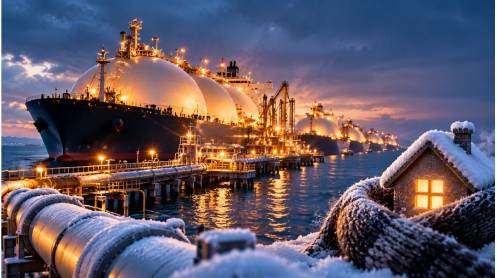
Pakistan’s liquefied natural gas (LNG) supply is similarly concentrated. Of the 8.4 million tonnes per year covered by its active medium- and long-term LNG contracts, 7.5 million tonnes are linked to Qatari projects, according to the Center for Strategic and International Studies, 2026. That makes the security of Gulf energy routes an economic issue for Pakistan, not simply a foreign policy concern.
Energy security for Pakistan has to encompass not only the availability and price of oil and LNG, but also shipping, insurance, storage and alternative routes.
A prolonged disruption can raise energy and transport costs, increase pressure on the import bill and make it harder for businesses and households to absorb higher prices. The IMF has warned that sustained disruption to physical fuel supplies could have a larger impact on Pakistan’s economic activity than higher international prices alone.
The economic transmission mechanism is straightforward. A disruption to energy supplies raises the cost of imported fuel and freight. That increases the landed cost of energy, puts pressure on the import bill and can increase demand for foreign exchange. Higher transport and energy costs then feed into production, food distribution and household consumption. If the shock persists, the result can be greater inflationary pressure, weaker industrial margins and slower investment. For an economy managing its external financing needs, this is more than an energy problem. It is a balance-of-payments risk.
The IMF has also highlighted Pakistan’s wider exposure to the Gulf. A significant disruption to GCC economies could affect remittances, which are an important source of financing for consumption and the balance of payments.* This means that Pakistan faces a potential double exposure: higher energy costs on one side and weaker external inflows on the other. This gives Pakistan a direct economic interest in regional stability.
Pakistan and Iran reported “significant progress” in talks on August 25, 2026 aimed at de-escalation and a peaceful resolution, with discussions also addressing the Strait of Hormuz. Qatar and Oman have also been pursuing diplomatic efforts concerning the Strait and maritime security.* The diplomatic situation remains fluid, with oil prices nearing six-week highs on September 7, creeping closer to $100 a barrel, as tit-for-tat strikes between the US and Iran on vessels sailing in the Strait of Hormuz and other areas kept crude oil flows in the Middle East low.
No single country can determine the outcome of the confrontation. Pakistan’s role should therefore not be judged by whether it can deliver a final settlement between Washington and Tehran. Its contribution can be more modest and still economically important: keeping communication open and supporting efforts that reduce the risk of a prolonged disruption to regional energy flows.
Pakistan is also beginning to address the practical side of this vulnerability. The country’s largest oil refiner, Cnergyico, has increased US crude imports in response to the disruption. It imported about 8.1 million barrels of US crude over nine months, including about 7.1 million barrels worth approximately $750 million during the fiscal year ended June 2026. The company is also considering additional purchases and plans to add a second offshore mooring as part of a wider upgrade.
These measures should not be seen as replacing Pakistan’s established Gulf energy relationships. Rather, they point toward a more resilient approach in which alternative suppliers, adequate storage, and additional transport routes provide flexibility when normal trade is disrupted.
Asia needs a broader energy security strategy
The crisis offers a lesson that goes beyond Pakistan. Asian economies have traditionally treated energy security largely as a question of supply: how much oil and gas they can secure, from which producers and at what price. The Hormuz disruption shows that transport security is equally important. Diversifying suppliers does not eliminate vulnerability if a large share of supplies still depends on the same maritime chokepoint.
For Asia, the strategic question is therefore not simply where energy is purchased, but how it reaches consumers. Energy security increasingly needs to be viewed as a system that includes reserves, pipelines, ports, shipping capacity, insurance and cross-border coordination.
Asian governments should therefore strengthen energy resilience in several ways.
Oil reserves and LNG storage can provide valuable time when shipping is disrupted. Regional information sharing and emergency supply arrangements could make those reserves more effective. Countries with larger reserves could explore ways to make emergency supplies available to regional markets, while countries with smaller reserves could strengthen domestic storage and demand-management arrangements. The objective is to give economies more time to adjust when normal supply routes are interrupted.
Alternative pipelines, ports and shipping arrangements can reduce dependence on individual chokepoints. The Energy Information Administration (EIA) notes that Saudi Arabia has rerouted some crude away from Hormuz through its East-West pipeline to the Red Sea port of Yanbu. Such infrastructure cannot eliminate dependence on the Strait, but it can reduce the proportion of supplies that must pass through it.
For Pakistan, this principle is particularly relevant. Greater storage capacity, additional offshore infrastructure and access to alternative suppliers can provide flexibility even when the country’s fundamental dependence on Gulf energy cannot be eliminated.
More flexible contracts, emergency cargo arrangements and better information sharing could reduce the scramble for supplies when markets are disrupted. Asian importers could also develop practical regional arrangements covering emergency cargoes, shipping information and demand management. Such cooperation would not require countries to surrender control over their national energy policies; it would simply improve their collective ability to respond to an unexpected disruption.
Renewable power, nuclear energy, storage, efficiency and electrification should increasingly be viewed as energy-security investments as well as climate policies. The objective is not to eliminate oil and gas dependence overnight. It is to reduce the economic damage when imported fuel becomes temporarily unavailable or significantly more expensive. Every additional unit of reliable domestic or diversified energy capacity reduces, at the margin, exposure to an external supply shock.
Energy security also depends on shipping capacity, insurance, port infrastructure and trade finance. A country may have access to crude or LNG in principle but still face difficulties moving, insuring or financing a cargo during a major disruption.
Infrastructure can provide alternative routes, but diplomacy is needed to keep strategic waterways open. The current crisis demonstrates that political stability around energy corridors has an economic value of its own.
This is where Pakistan’s experience has wider relevance. Its geographical position, economic links with the Gulf and proximity to Iran give it a strong interest in de-escalation. Other Asian countries have different diplomatic relationships and strategic priorities, but they share the same economic interest in keeping energy corridors open and predictable.
For Pakistan, regional stability would provide an immediate economic benefit. If tensions eventually ease, there could also be greater scope for legitimate border trade and carefully managed economic cooperation with Iran, subject to international sanctions and other constraints. Such opportunities should, however, be approached cautiously. The immediate priority should be to reduce the economic risks created by regional instability and strengthen Pakistan’s capacity to withstand future supply disruptions.
This also means looking beyond the current crisis. Pakistan’s energy planning should give greater weight to storage capacity, diversification of import sources, alternative maritime routes, energy efficiency and domestic generation. These are not merely energy-sector policies. They are measures to protect the country’s external account, industrial competitiveness and economic stability.
For Asian economies more broadly, energy resilience should become part of economic planning rather than being treated solely as an issue for energy ministries. Finance, trade, transport and foreign-policy institutions all have a role to play because a disruption in an energy corridor can quickly become a problem for the wider economy. But the larger opportunity is not about what Pakistan can gain from the crisis. It is about what Asia should learn from it.
Asia has become the centre of global manufacturing and a major energy-consuming region, yet its economic security remains exposed to a handful of strategic waterways. The disruption of Hormuz has shown how quickly a geopolitical conflict can become an energy, shipping and inflation problem far beyond the Middle East.
The lesson is not that Asia can eliminate its dependence on the Gulf. That is neither realistic nor necessary. The lesson is that this dependence needs to be managed better – through adequate buffers, diversified routes and suppliers, flexible contracts, stronger domestic energy systems and sustained diplomatic engagement.
Pakistan’s diplomatic engagement therefore matters beyond its borders. It illustrates a broader economic reality: For Asia, energy security is no longer just about securing supplies. It is also about securing the routes and the diplomacy that keep those supplies moving.