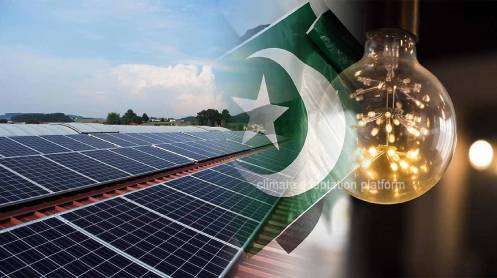
ISLAMABAD: Pakistan’s rapid solarisation drive helped shield the country from the global energy crisis triggered by the recent US-Israel conflict with Iran, energy experts said at the Breathe Pakistan International Climate Conference 2026, while emphasising that battery storage systems are now the critical missing link in the country’s clean energy transition.
Speaking during a panel discussion titled “Empowering Pakistan’s Transition to Clean Energy,” experts highlighted how the country’s growing reliance on solar energy reduced dependence on imported fossil fuels and protected consumers from severe power disruptions during regional tensions.
The session, moderated by Ammar H. Khan of the National Credit Guarantee Company Limited, focused on the future of renewable energy, distributed grids, and energy storage solutions in Pakistan.
Haneea Isaad, Energy Finance Specialist at the Institute for Energy Economics and Financial Analysis (IEEFA), said Pakistan had managed the ongoing energy crisis relatively well, with no major fuel shortages despite instability in the Middle East.
“Over the past three to four years, we have witnessed a steady decline in fossil fuel consumption, including oil, gas, and coal,” she said.
Ms Isaad noted that Pakistan’s aggressive solar adoption accelerated after the Russia-Ukraine conflict in 2022. According to her, Pakistan imported nearly 50GW of solar panels between 2021 and 2025, with almost half of the capacity already installed nationwide.
She stated that this rapid solarisation played a key role in preventing widespread power outages amid current regional energy uncertainties.
Director of the LUMS Energy Institute, Dr Naveed Arshad, remarked that while the Ukraine war accelerated solar adoption globally, the ongoing Iran-US tensions could become the driving force behind a battery storage revolution in Pakistan.
He described Pakistan’s energy transformation as a unique shift from a centrally connected grid system to a distributed energy model powered by solarisation, storage, microgrids, digitalisation, energy conservation, and circularity.
“We have witnessed a very interesting revolution of the grid that has not been seen in many countries,” he said, adding that much of this transition occurred without relying heavily on international climate financing.
Founder of People of Asia for Climate Solutions, Tom Xiaojun Wang, termed renewable energy an antidote to rising “energy anxiety” caused by soaring fuel prices.
He stressed that renewable technologies were now both affordable and accessible, while calling for stronger policies and smarter financing mechanisms to accelerate clean energy deployment.
Kamran Siddiqui, Programme Officer for Energy and Infrastructure at International Renewable Energy Agency (IRENA), highlighted the urgent need for investment in grid infrastructure to support Pakistan’s renewable energy expansion.
“We need to determine how energy will be deployed — whether through behind-the-meter systems or net-metering,” he said.
He also pointed to the increasing import of solar batteries over the past three years, noting that battery storage adoption was steadily growing alongside solar installations.
However, he acknowledged that the solar boom had created new challenges for the national grid as demand for conventional electricity supply continued to decline.
Kamran Siddiqui noted that solar technology costs had fallen by nearly 87 per cent over the past decade, while battery prices had also dropped significantly, making storage solutions increasingly viable for consumers.
He described battery storage systems as the “missing link” in Pakistan’s solar revolution, enabling consumers to reduce dependence on the national grid.
“Consumers are no longer captive to the grid,” he said, adding that the government-run electricity network would now have to compete with alternative energy solutions such as solar and battery systems.
Story by Zaki Abbas