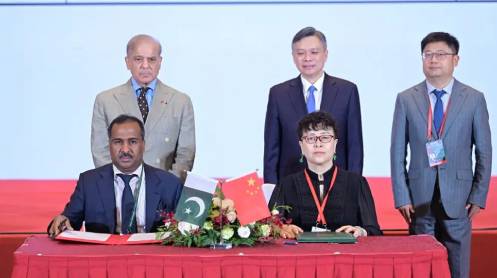
HANGZHOU, China: Pakistani and Chinese companies signed agreements and memorandums of understanding (MoUs) worth more than $7 billion during the Pakistan-China B2B Investment Conference on IT & Telecom, Battery Energy Storage Systems (BESS), and Agriculture held in Hangzhou.
Addressing the conference, Prime Minister Shehbaz Sharif invited Chinese companies to relocate industries to Pakistan, establish joint ventures with local firms, and benefit from the country’s investor-friendly policies, describing the proposal as a “win-win model” for both nations.
The prime minister noted that rising labour costs in China and the country’s shift toward higher-end industrialisation had created opportunities for industries to move production facilities to Pakistan.
He said Chinese companies could bring plant and machinery to Pakistan, partner with Pakistani entrepreneurs, manufacture products locally, and export them to third countries.
“This model will be a roaring success in textiles, leather, and many other sectors,” the prime minister remarked, while encouraging Chinese investors to explore opportunities in Pakistan’s export zones, particularly in Karachi.
Highlighting Pakistan’s mineral wealth, he said the country possessed vast reserves of minerals and gemstones, offering significant investment potential for Chinese firms.
On the agriculture sector, Prime Minister Shehbaz Sharif said Pakistan was fundamentally an agrarian economy and stressed the need for collaboration in advanced seed technology, mechanisation, and modern agricultural practices to improve productivity.
He noted that China imports nearly $100 billion worth of agricultural products annually, while Pakistan’s share remained minimal despite the country’s huge potential.
The prime minister expressed confidence that bilateral cooperation in agriculture could generate large-scale rural employment, support small and medium enterprises, and significantly increase Pakistan’s agri exports to China.
He projected that Pakistan’s agricultural exports to China could increase by $10 billion within the next five to seven years.
The prime minister also highlighted opportunities in information technology, artificial intelligence, and special economic zones (SEZs). He revealed that a new export-oriented special economic zone spanning more than 6,000 acres was being developed in Karachi with world-class infrastructure, one-window operations, and long-term lease facilities for investors.
“We are looking for expertise, experience, and investment — not loans or handouts,” he stated, emphasizing Pakistan’s desire for sustainable economic partnerships.
Prime Minister Shehbaz Sharif praised the leadership of Xi Jinping and reiterated that Pakistan-China relations had grown stronger over the decades, describing the friendship as “deeper than the deepest ocean and higher than the Himalayas.”
He said several MoUs signed during recent business forums in Shenzhen, Beijing, and Hangzhou had already begun converting into practical agreements worth billions of dollars.
Deputy Prime Minister Ishaq Dar, Zhejiang Governor Liu Jie, Federal Minister for IT Shaza Fatima Khawaja, Information Minister Attaullah Tarar, Federal Minister Rana Tanveer Hussain, Special Assistant Haroon Akhtar Khan, Pakistan’s Ambassador to China Khalil Hashmi, and leading business executives from both countries attended the conference.
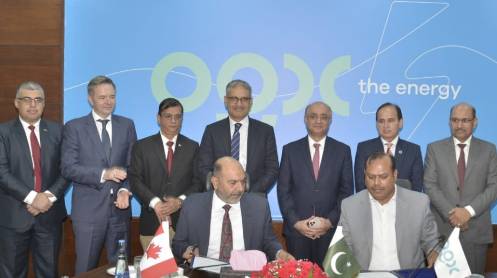
Among the major agreements signed, Haolu Engineering and Technology Company Limited and Fauji Fertilizer Company signed a $1.12 billion agreement for fertilizer production.
Additionally, a $100 million MoU was signed between IBI Beijing United Information Technology Company and RIC for agrochemicals, agricultural machinery production, and the establishment of a regional office in Multan.
Officials said that more than 200 MoUs worth over $20 billion have been signed so far through five Pakistan-China business-to-business conferences.